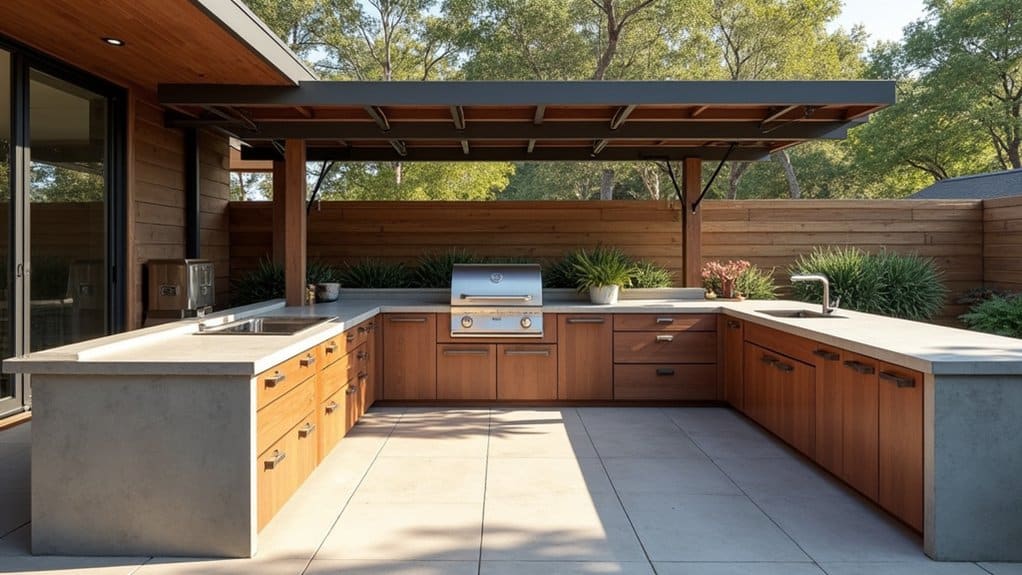
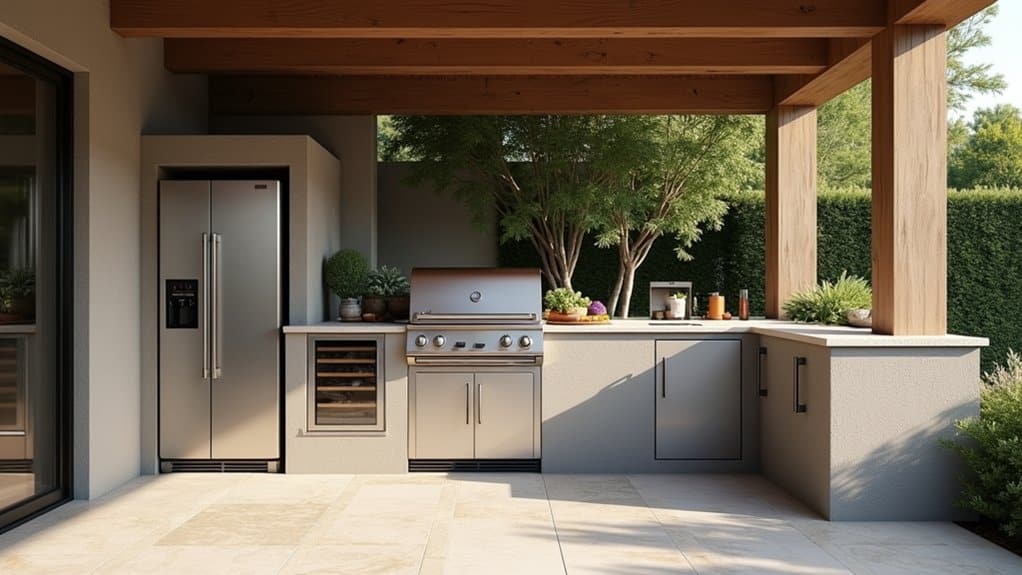
Your ouutdoor pergola’s final price depends on five key factors: size ($20, $60 per square foot), material selection (from $10/sq ft for pressure-treated pine to $60/sq ft for fiberglass), whether you choose prefab ($1,000, $7,000) or custom ($5,000, $18,000), roof style (retractable canopies at $4, $10/sq ft versus louvered roofs at $45, $175/sq ft), and installation costs ($1,500, $8,000). Understanding how these factors interact will help you build the perfect pergola within your budget.
Pergola Size Sets Your Starting Price at $20, $60 per Square Foot
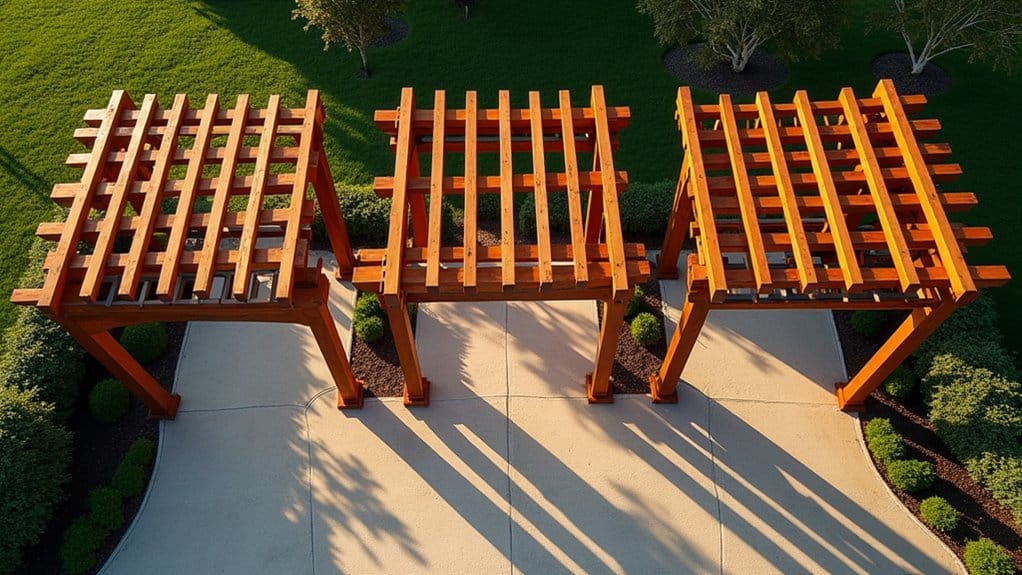
Pergola size directly determines your baseline cost, with most projects running $20, $60 per square foot installed. A basic 8×8 structure starts at $640, while a 20×20 installation reaches $12,000, $26,000 for custom builds. Prefabricated kits drop your cost to $10, $40 per square foot, making them budget-friendly options for standard sizes.
Your square footage multiplies quickly. A 12×12 pergola covers 144 square feet, costing $2,880, $8,640 depending on materials and design customization choices. Jump to 24×24, and you’re looking at $17,900, $37,400 for custom detailing and professional installation. A typical 10×12 foot pergola costs $6,000 to $10,000, giving you a reliable benchmark for mid-sized projects.
Labor adds $50, $120 per hour to your total. Larger structures require extended build times and additional crew members. Labor costs typically account for $500, $1,000 of your total project expense. Professional installation typically runs $1,500, $5,000 depending on the complexity of your pergola design. Before selecting dimensions, calculate your usable outdoor space and intended function, oversizing wastes money while undersizing limits your pergola’s practical value.
Pergola Materials Create the Widest Price Swings
While size establishes your baseline budget, material selection creates price variations of 500% or more between the cheapest and most expensive options. Pressure-treated pine starts at $10 per square foot, while fiberglass reaches $60 per square foot, a dramatic cost difference for identical dimensions.
Aluminum and vinyl pergolas range from $10, $30 per square foot, offering rust resistance and minimal maintenance. Aluminum stands out as the most durable option because it resists rot, rust, and fading over time. Cedar costs $25, $35 per square foot, balancing traditional aesthetics with natural rot protection. Premium woods like teak and ipe command $35, $55 per square foot for superior durability. Standard wood pergolas have the lowest upfront cost but require recurring maintenance expenses that should be factored into your long-term budget.
Your structural loading requirements influence material choice greatly. Steel handles heavy loads but increases costs substantially, ranging from $30, $70 per square foot. Fiberglass supports specialized customization options and large-span designs, though limited availability restricts purchasing flexibility in some regions.
Prefab vs. Custom Pergolas: A $5,000+ Difference
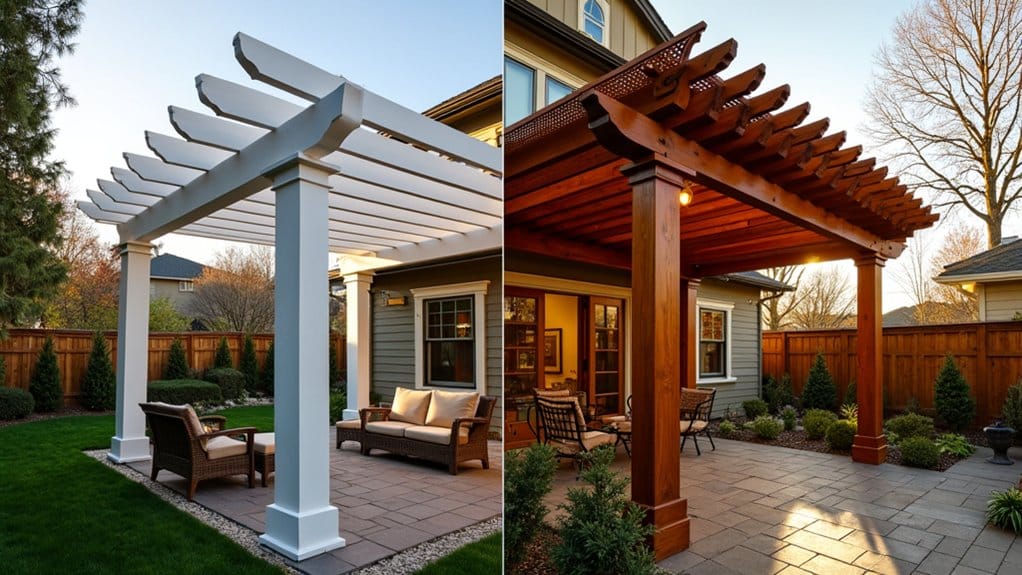
Choosing between prefab kits and custom builds creates the single largest cost decision beyond materials, often exceeding $5,000 in total project difference.
Prefab kits range from $1,000 to $7,000 upfront, with total installed costs between $1,550 and $4,100. Custom pergolas start at $5,000 and climb past $18,000, bringing total expenses to $4,700 to $14,500 including labor.
Your customization demands drive this gap. Prefab offers standardized sizes and pre-cut components, you’ll assemble them quickly but sacrifice design control. Custom builds accommodate unique spaces, exact specifications, and tailored aesthetics, though project complexity extends timelines through design phases, permits, and professional construction.
Consider durability tradeoffs: custom uses superior materials built to professional standards, enhancing long-term value. Custom pergolas featuring traditional mortise-and-tenon joinery can last 25-50+ years compared to prefab options. Prefab durability varies, potentially requiring earlier replacement. Factor labor differences too, $500 to $2,000 for prefab versus $2,100 to $6,000 for custom installation. Beyond durability, a well-built custom pergola can add value and enhance curb appeal of your home, potentially offsetting some of the higher initial investment. Ongoing costs also differ significantly, with prefab kits requiring annual maintenance of $50 to $100 compared to $100 to $500 for custom-built structures.
Roof Style Can Double Your Pergola Costs
How dramatically does your roof choice impact the final price tag? Your roof construction materials alone can push costs from $4 per square foot to $175 per square foot, a staggering 40x difference.
Basic retractable canopy roofs run $4, $10 per square foot installed, making them the budget-friendly option. Wood lattice roofs step up to $25, $50 per square foot, with cedar and redwood commanding premium prices.
Louvered roofs represent the highest investment at $45, $175 per square foot. Manual systems start at $45, while smart motorized versions with Wi-Fi sensors reach $175. These roof feature add ons can double your entire pergola budget, transforming a $10,000 project into $21,500.
Solid pavilion roofs offer middle-ground pricing at $35, $60 per square foot while providing full weather coverage. For comparison, a traditional gable roof structure costs $13,000 to $30,000 and matches traditional home architecture if you’re considering a fully enclosed option. Before installation begins, you may also need to budget for site preparation like leveling or concrete work, which affects your overall cost.
Pergola Installation Adds $1,500, $8,000
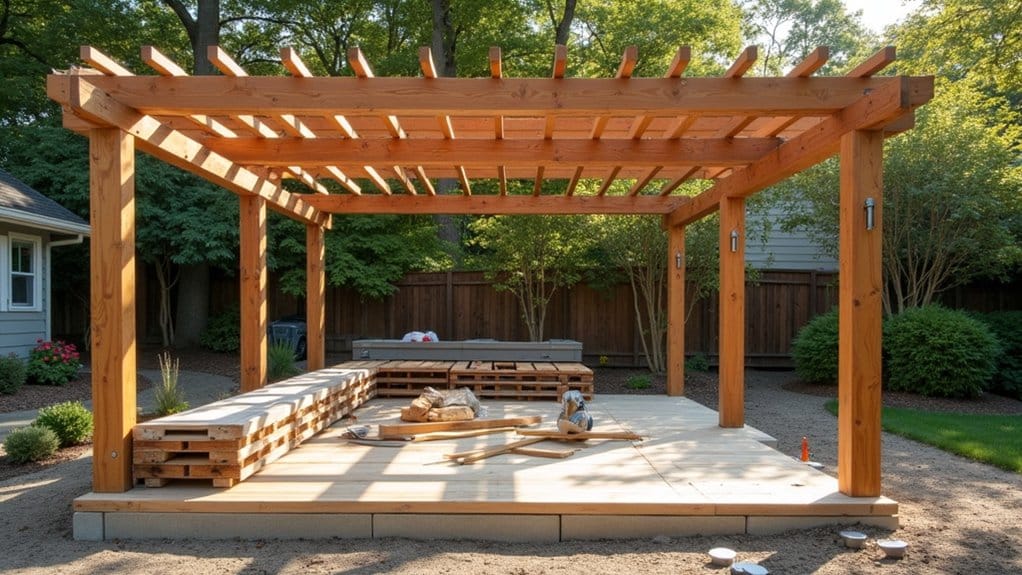
Professional installation typically runs $1,500 to $5,000, though complex projects can push that figure to $8,000 or higher. Your final labor costs depend heavily on site conditions, favorable terrain keeps costs at the lower end, while foundation work or electrical wiring adds significant fees.
Regional variations also impact your budget substantially. Denver’s basic installations average $1,500 to $2,000, but Colorado’s professionally installed pergolas typically range $5,500 to $7,800. Wood pergola labor alone costs $107 to $149 per square foot in 2025. A 129 square foot custom wood pergola with site-built redwood or cedar construction typically ranges from $10,199.90 to $12,537.80 for materials and basic labor combined.
Size drives costs predictably: an 8×8 ft structure runs $1,500 to $3,000, while a 12×12 ft pergola costs $5,000 to $9,000. Larger structures like 16×16 or 20×20 ft pergolas can cost upwards of $12,000 to $25,000. If you’re building over 200 square feet, you’ll need permits in areas like El Paso County, adding more expense to your project. Upgrading to specialty designs like remote-controlled roof pergolas can cost $80 to $120 per square foot, significantly increasing your overall investment.
Frequently Asked Questions
Do I Need a Permit to Build a Pergola in My Backyard?
You’ll likely need a permit depending on your pergola’s size and design. Most areas exempt freestanding structures under 120 square feet and 10 feet tall, but larger builds require approval. Check your local building codes first, they’re typically stricter than state requirements. Review zoning regulations for setbacks, height limits, and material restrictions. Attached pergolas usually mandate permits regardless of size. Skipping this step risks fines, removal orders, and complications when selling your property.
How Long Does a Typical Pergola Installation Take From Start to Finish?
You’ll typically complete a pergola installation in 3 to 8 weeks from signed contract to finished build. The typical construction duration on-site takes just 1 to 3 days, but factors impacting installation timeline include material type, permitting requirements, and customization level. StruXure motorized systems require 6 to 8 weeks for fabrication, while Alumawood kits arrive in 1 to 2 weeks. If you’re DIY-ing, expect 1 to 2 days with helpers.
Does Adding a Pergola Increase My Home’s Resale Value?
Yes, adding a pergola typically delivers 50-80% ROI on your investment. You’ll see increased home value of up to 12.4%, with higher curb appeal driving faster sales and premium offers. Quality materials like cedar or aluminum maximize returns, while features such as adjustable louvers boost perceived worth by 15-20%. Warm-climate markets yield the strongest gains, up to 20% in competitive areas where outdoor living spaces command top dollar.
What Foundation Type Works Best for My Existing Patio or Deck?
For existing patios, you’ll get the best results with a concrete slab foundation using surface-mount brackets, it’s cost-effective and requires no digging. If your patio can’t support the load, consider a post anchored foundation with expansion bolts drilled directly through the surface. For decks, screw piles or pier foundations work well since they’re non-intrusive and handle uneven ground efficiently while minimizing material costs.
How Much Maintenance Do Different Pergola Materials Require Annually?
You’ll find aluminum and fiberglass require the least ongoing material upkeep costs, just annual washing and rare bolt tightening. Vinyl needs only yearly power washing with no sealing. Wood demands the most attention: you’ll re-stain every 1, 3 years, treat for pests, and conduct periodic structural inspections after harsh weather. Factor these maintenance differences into your budget, as wood’s lower upfront cost often increases over time through labor and materials.