
The five best worktops for your outdoor kitchen in 2026 are granite, quartzite, porcelain, Dekton, and quartz. Granite offers exceptional scratch resistance and handles hot cookware directly. Quartzite withstands temperatures up to 300°F near grills. Porcelain’s nonporous surface resists UV fading and moisture without sealing. Dekton’s sinterized technology provides near-zero porosity for extreme climates. Quartz works well in covered spaces with UV-resistant sealants. Each material brings distinct advantages depending on your climate and sun exposure.
Granite Outdoor Countertops for Year-Round Durability
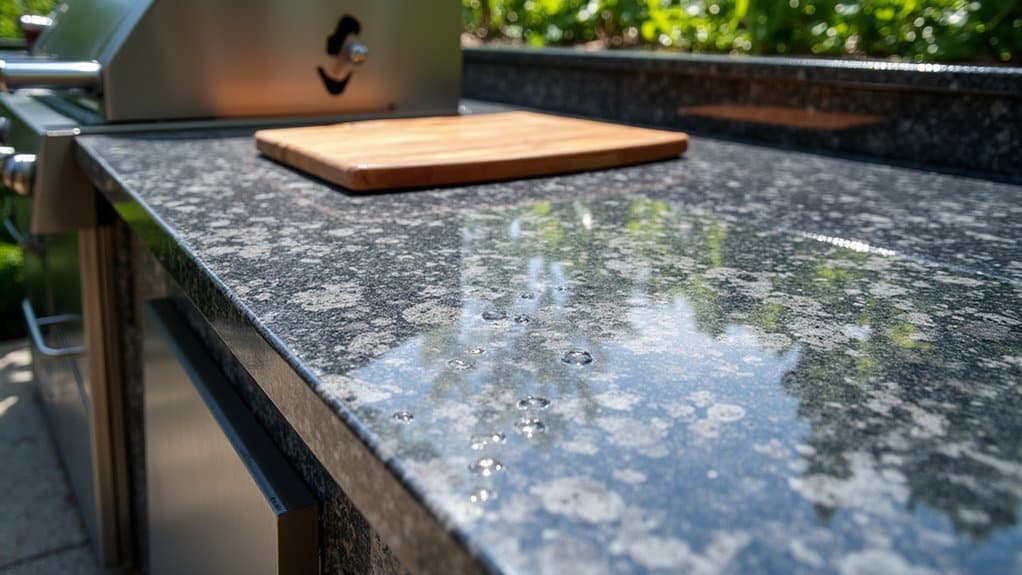
When you’re building an outdoor kitchen that needs to withstand everything nature throws at it, granite stands out as a premier countertop choice. Its crystalline structure, composed of quartz, feldspar, and mica, creates a surface harder than steel knives, resisting heat, cold, rain, and UV rays without warping or cracking. This exceptional scratch and chip resistance makes granite ideal for high-traffic areas where food preparation and entertaining are frequent activities. The material’s heat resistance allows you to place hot cookware directly on the surface without causing damage.
Granite slab maintenance requirements are straightforward: apply a penetrating sealer annually and clean with mild soap and water. Dark varieties like Absolute Black and Ubatuba resist fading and staining better than lighter options. A leathered or honed finish is often better suited for outdoor kitchens than a polished finish, as it helps reduce glare and hides wear more effectively.
The granite surface aesthetic design options are extensive, with each slab offering unique natural patterns. You’ll find colors and finishes that complement any style, from rustic patios to sleek cooking stations, delivering both durability and elegance for years.
Quartzite Outdoor Countertops for Heat and UV Resistance
Although granite offers exceptional outdoor durability, quartzite takes heat resistance a step further with its metamorphic origins forged under extreme geological temperatures and pressures. You’ll find quartzite withstands temperatures up to 300°F, making it ideal for placement near grills and fire features. Its thermal conductivity allows the surface to handle hot cookware without cracking or discoloration. However, be mindful that sudden temperature changes can potentially cause damage, so avoid placing ice-cold items directly on sun-heated surfaces.
Rating 7-8 on the Mohs hardness scale, quartzite resists scratches while maintaining its aesthetic appeal under harsh sun exposure. When comparing natural stone options, quartzite proves more heat resistant than granite due to its formation from sandstone under intense geological conditions. This makes quartzite an excellent choice for outdoor kitchens with significant cooking and baking activities. For low maintenance performance, seal your quartzite every 1-2 years to protect against stains and preserve its heat-resistant barrier. Use trivets to safeguard the sealant from degradation. This natural stone outperforms engineered quartz, which contains resins that break down above 300°F.
Porcelain Outdoor Countertops That Resist Weather and Stains
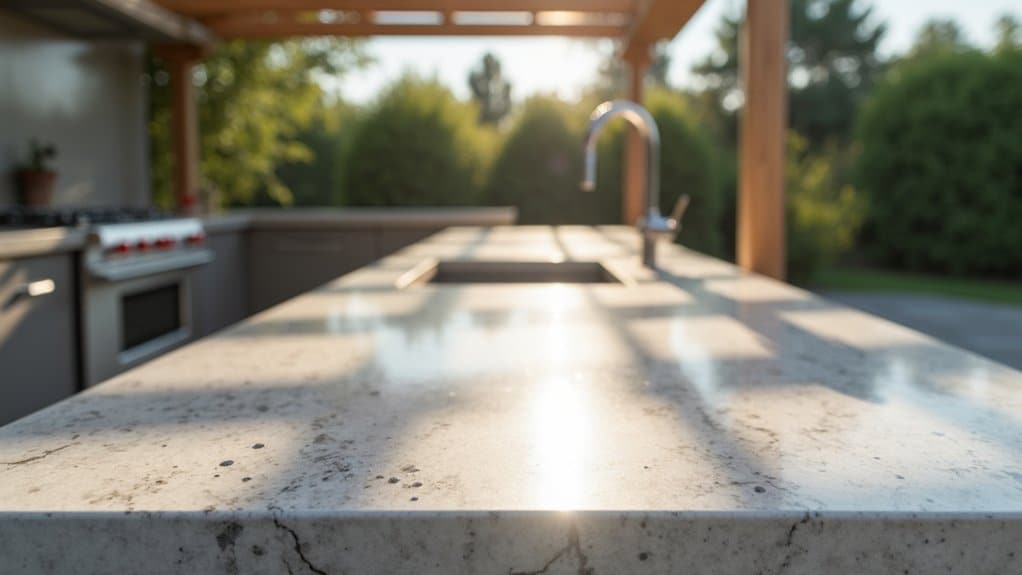
Because porcelain slabs are fired at temperatures exceeding 2,200°F, they emerge as one of the most weather-resistant countertop materials you can install outdoors. This high-temperature process creates a nonporous surface that absorbs less than 0.5% water, making it virtually impervious to rain, humidity, and freeze-thaw cycles that crack natural stone.
You’ll appreciate porcelain’s impact resistant design, which delivers nearly 30% more strength than granite. UV exposure won’t fade or yellow the surface, and thermal shock from hot cookware poses no threat. The nonporous composition naturally repels oils, food stains, and bacteria without sealing. The durable surface also serves as an ideal cutting area, eliminating the need for separate chopping boards during food preparation. This density makes porcelain ideal for pool-adjacent outdoor kitchens where constant moisture exposure would damage other materials.
For maintenance free performance, porcelain requires only simple wipe-downs after spills. It won’t discolor from outdoor cooking mishaps or absorb particles that compromise hygiene. While the surface holds up exceptionally well, be aware that porcelain can chip if heavy objects like cast iron grills or tools are dropped on it, particularly near edges. Expect decades of reliable service in any climate.
Dekton Outdoor Countertops for Extreme Climates
Dekton’s ultra-compact surface undergoes a process called Sinterized Particle Technology, which fuses raw materials at nearly 25,000 tons of pressure to create a countertop that thrives where other materials fail. You’ll appreciate its exceptional moisture resistance, the near-zero porosity blocks liquids, stains, and bacterial growth without guaranteeing.
| Feature | Performance Benefit |
|---|---|
| UV Resistance | No fading or yellowing in direct sunlight |
| Thermal Stability | Handles temperature extremes without cracking |
| Impact Durability | Resists scratches, chips, and heavy impacts |
Whether you’re grilling in scorching summers or hosting through frosty winters, Dekton won’t warp, discolor, or deteriorate. Its low thermal expansion coefficient confirms stability during rapid temperature shifts. Backed by a 25-year warranty, it demands only soap-and-water maintenance for lasting performance. With large-format slabs available up to 3,200 x 1,400 mm, you can achieve seamless coverage across expansive outdoor cooking stations with minimal joints. The versatile thickness options ranging from 4 to 30 millimeters allow you to customize the countertop profile to match your specific design vision and structural requirements. The material is comprised of porcelain, glass, and quartz, which are subjected to temperatures up to 1,200°C during manufacturing to achieve its remarkable durability.
Quartz Outdoor Countertops That Won’t Fade in Sun
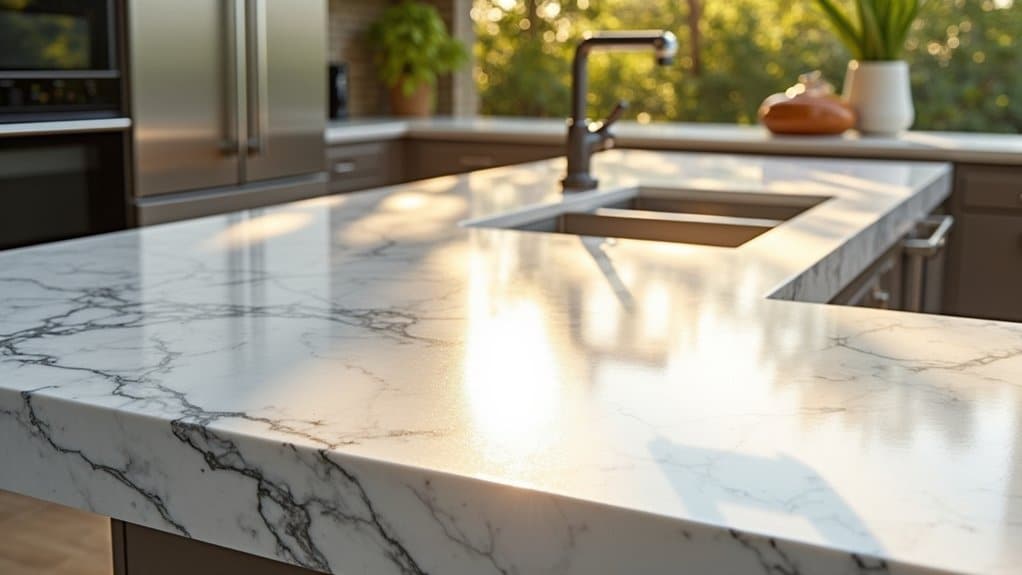
However, heat and moisture compound the challenges. Temperature fluctuations risk cracking, while prolonged humidity degrades resin integrity. The resins and polymers that bind quartz crystals together are particularly vulnerable to UV ray damage, causing fading and loss of luster over time. Most manufacturers exclude outdoor installations from warranties for these reasons. Installing UV-blocking window films on nearby structures can block up to 99% of harmful rays if you’re determined to use quartz in a partially covered space. Applying UV-resistant sealants can provide an additional layer of protection against sun damage.
For full-sun locations, consider porcelain or Dekton instead. Reserve quartz for covered outdoor kitchens where it can maintain its aesthetic appeal.
Frequently Asked Questions
Can I Place a Hot Grill Directly on My Outdoor Countertop?
Yes, you can place a hot grill directly on your countertop, if you’ve chosen the right material. Granite, stainless steel, and soapstone offer excellent heat tolerance for high-temperature cooking without warping or discoloration. However, you’ll want to avoid quartz, laminate, and marble, which can’t handle sustained heat. Consider your cleaning requirements too; non-porous surfaces like stainless steel make post-grilling wipe-downs effortless while resisting weather-related wear.
How Often Should I Seal My Outdoor Kitchen Countertop?
You should seal your outdoor kitchen countertop at least once yearly, though harsh climates may require more frequent applications. Your proper sealant application schedule depends on the stone type, granite needs resealing every 1-2 years, while marble demands attention every 3-6 months. For maintenance tips for longevity, wipe surfaces 2-3 times weekly and use UV-stable sealers. Perform a water test regularly: if water absorbs rather than beads, it’s time to reseal.
Which Outdoor Countertop Material Works Best for Built-In Pizza Ovens?
Dekton and quartzite work best for built-in pizza ovens. You’ll appreciate Dekton‘s exceptional heat resistant properties, it withstands extreme temperatures without cracking or warping. Quartzite outperforms granite in thermal resistance while offering superior durability. Both materials feature moisture resistant features that prevent damage from outdoor exposure. Soapstone’s another solid choice, absorbing heat evenly and handling freeze-thaw cycles well. For lasting performance near high-heat cooking, prioritize these thermally stable options.
What Is the Average Cost Difference Between Outdoor Countertop Materials?
You’ll find significant price gaps between outdoor countertop materials. Budget-friendly ceramic tiles run $6, $50 per square foot, while premium quartz costs $55, $155. Mid-range options like granite and concrete fall between $50, $125. Material availability affects pricing, locally sourced stone often costs less. Consider environmental impact too; concrete and natural stone typically have smaller carbon footprints than manufactured alternatives. Weather-resistant materials may cost more upfront but deliver better long-term value.
How Do Outdoor Countertops Hold up Against Pool Chemicals and Saltwater?
Marine-grade polymer and powder-coated aluminum offer superior weather resistance against both pool chemicals and saltwater exposure. You’ll find concrete with epoxy coatings and solid surface materials handle chlorinated splashes without degrading. For saltwater environments, stainless-steel hardware paired with weatherproof cabinetry prevents corrosion. Your cleaning requirements stay minimal with non-porous options like porcelain and soapstone, which naturally resist chemical damage and don’t harbor bacteria or mold.