
The best pool deck materials balance slip resistance, durability, and design cohesion with your home’s architecture. Top options include poured concrete, concrete pavers, brick pavers, natural wood, composite decking, porcelain tile, natural stone, and travertine, each offering distinct advantages in heat dissipation, moisture resistance, and aesthetic versatility. You’ll want to weigh factors like wet-traction ratings, maintenance demands, and long-term cost before committing. Below, we break down each material’s performance, upkeep, and ideal use case.
What Makes a Great Pool Deck Material?
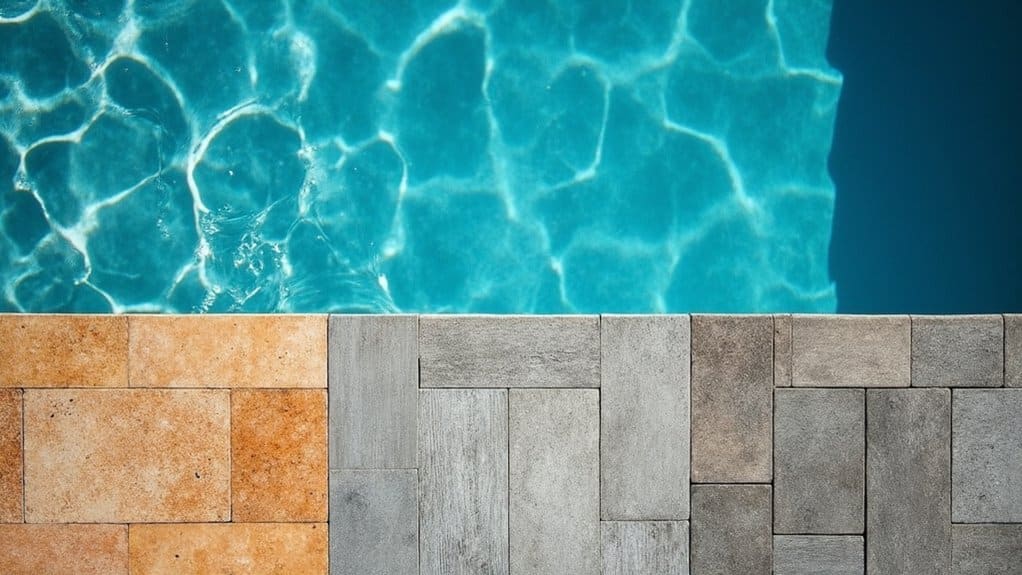
When you’re evaluating pool deck materials, the best options balance safety, durability, and design cohesion. You’ll want surfaces that resist slipping when wet, withstand constant moisture exposure, and complement your home’s architectural style.
Heat dissipation properties matter considerably, materials like travertine and porcelain tile stay cool underfoot, while darker surfaces can become uncomfortably hot. Consider how each material handles UV exposure, chlorinated water, and freeze-thaw cycles in your climate.
Costing and installation vary widely between options. Porcelain tile and natural stone require skilled labor, while composite decking offers straightforward installation with minimal long-term maintenance. You should also factor in replaceability; individual pavers swap out easily, whereas poured surfaces demand more extensive repairs. Prioritize materials that deliver lasting performance without excessive upkeep. Synthetic decking, made from recycled plastic and PVC, requires the least maintenance of all options and offers the longest lifespan, making it a cost-effective choice over time.
Poured Concrete Pool Decks: Affordable and Customizable
Poured concrete remains one of the most versatile and budget-friendly pool deck materials available, offering a combination of durability, customization, and performance that’s hard to match at its price point. At $5, $18 per square foot, you’ll save up to 50% compared to pavers or natural stone while achieving durable performance that lasts decades.
You can choose broom-finished surfaces at $5, $8 per square foot or opt for stamped and textured options that replicate high-end materials. UV-resistant pigments prevent fading, and treatable finishes reduce slip hazards around wet areas. Concrete resists pool chemicals, mold, and algae growth, ensuring low cost maintenance over its lifespan. It bridges minor ground movements and withstands extreme temperatures without frequent repairs. The installation process can take several days, including pouring, stamping, and sealing, so you should plan for disruption to pool usage during that time.
Concrete Paver Pool Decks: Versatile Designs on Any Budget
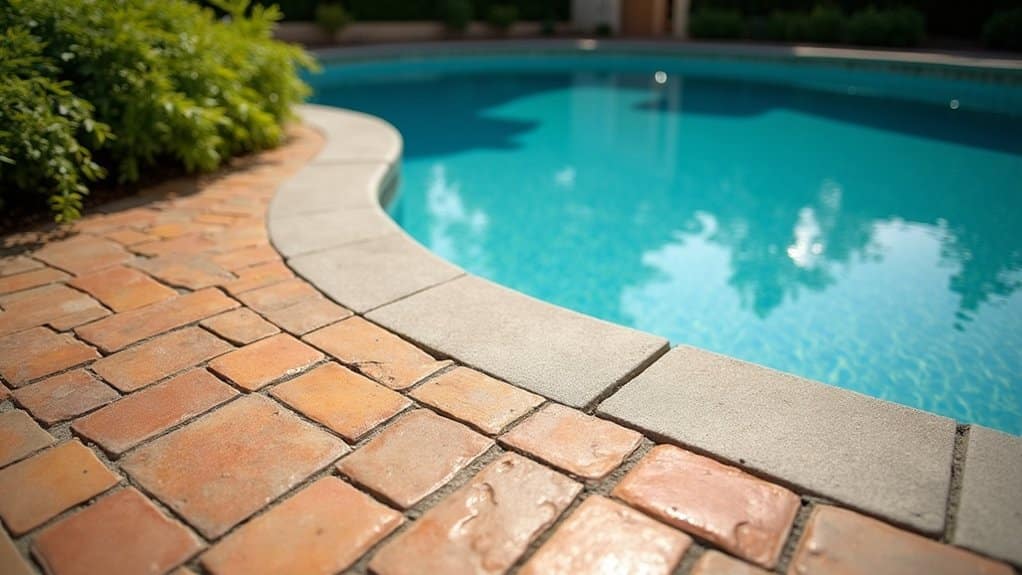
Concrete pavers give you the flexibility to swap out a single damaged unit without tearing up your entire deck, a repair advantage poured concrete can’t match. You can mix colors, textures, and interlocking patterns to create custom layouts that complement any backyard style or budget. Because each paver is pressed at over 9,000 PSI with color embedded throughout, your design stays vibrant and structurally sound for years. Pavers also tend to stay cooler underfoot than poured concrete, making them a more comfortable choice for bare feet on hot summer days.
Easy Individual Replacement
- Single paver replacement eliminates $5,400, $13,500 in full deck demo expenses
- Repair labor runs $5, $10 per square foot versus $10, $40 for complete resurfacing
- Edge restraints and joint sand enable quick disassembly without disturbing adjacent units
- Spot fixes extend your deck’s functional lifespan 8, 15 years
Unlike monolithic poured concrete, pavers won’t propagate cracks during partial repairs. Your base preparation and layout determine future maintenance ease, plan accordingly.
Wide Design Options
Few pool deck materials match concrete pavers’ design range, you’ll choose from stacked bond, running bond, herringbone, chevron, hexagon, and random multi-size layouts, each delivering a distinct visual rhythm. Enclosed patterns, like octagonal fields with rectangular borders, add layered complexity, while alternating sections embed herringbone within stacked bond for dynamic contrast.
Your color selection spans off-whites, creams, and tans that mimic natural stone while reducing surface heat absorption. Textured finishes provide critical slip resistance around wet zones, and non-skid sealants add further traction compliance.
Installation flexibility stems from dimensionally compatible pavers sized in four-inch increments, streamlining cuts and layout efficiency. Carvestone overlays replicate flagstone or travertine aesthetics at lower cost. You’ll achieve natural stone elegance on virtually any budget without sacrificing safety or design precision.
Brick Paver Pool Decks: Slip-Resistant and Easy to Repair
Because brick pavers combine a naturally textured surface with a modular layout, they’ve become one of the most practical choices for pool decks that prioritize safety and long-term serviceability. Their inherent slip resistance exceeds the 0.42 DCOF minimum required for wet areas, and their long lasting durability withstands chlorine, UV exposure, and freeze-thaw cycles.
You’ll also benefit from cost effective installation and straightforward maintenance:
- Individual replacement, Swap damaged pavers without disturbing the surrounding deck.
- No-mortar assembly, Interlocking designs enable DIY repairs that preserve structural integrity.
- Polymeric sand joints, Inhibit weed growth while stabilizing each unit.
- Code-compliant drainage, A 1-2% slope paired with paver drains directs water away from your pool and house.
Regular sweeping and periodic sealing keep your deck performing for 20+ years.
Wood Pool Decks: Warm and Natural Underfoot
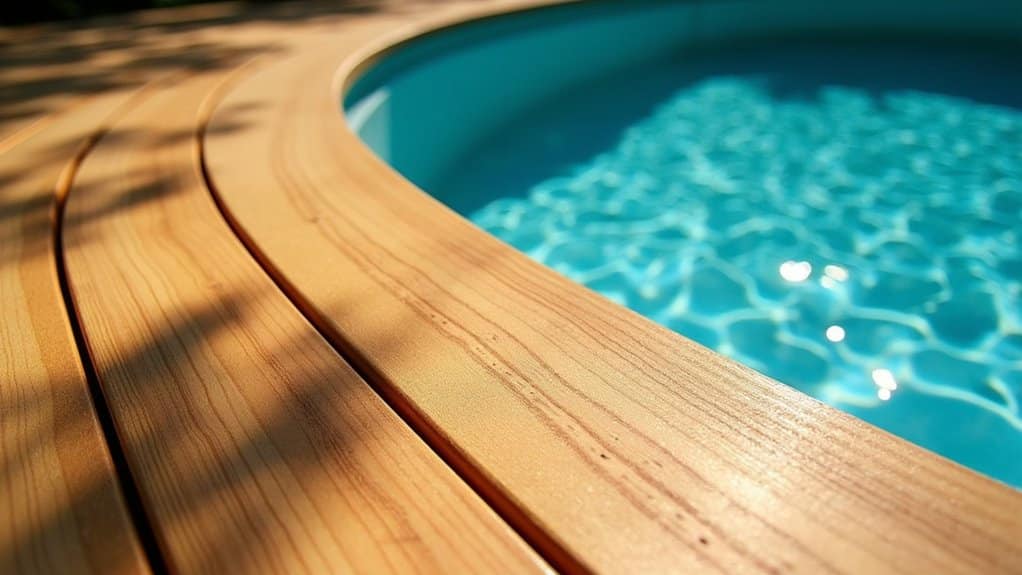
When you’re selecting wood for a pool deck, species choice directly impacts performance, pressure-treated lumber offers an economical baseline, while tropical hardwoods like Ipe and Cumaru deliver superior moisture resistance and longevity without chemical treatments. You’ll need to commit to regular sealing and staining cycles to protect against rot, warping, and chlorine-induced degradation, especially in splash zones where chemical exposure is constant. Properly textured wood surfaces provide reliable slip resistance underfoot, and you can further customize traction and appearance through finish selection and grain orientation during installation.
Natural Wood Varieties
Natural wood decking brings a tactile warmth and organic beauty that synthetic materials can’t replicate, though each species performs differently around water.
Your selection should balance climate suitability, visual appeal, and maintenance tolerance:
- Ipe, This ultra-dense tropical hardwood resists rot naturally and stays cooler underfoot than composites, lasting 10, 30 years with proper upkeep at $65, $85 per square foot installed.
- Teak, Its natural oils repel water and resist mold, delivering strong durability with lower maintenance than softwoods.
- Cedar, You’ll get pest and weather resistance at a fraction of teak’s cost, with textured profiles that reduce slip risk.
- Mahogany, The most durable wood option available, featuring elegant grain patterns and near-zero maintenance demands despite its premium price point.
Maintenance and Upkeep
Five core maintenance practices keep a wood pool deck structurally sound and visually sharp: regular cleaning, scheduled inspections, sealing and protection, timely repairs, and seasonal preventive care. Sweep debris regularly, rinse with a hose, and deep clean annually using a wood-safe cleaner.
Proactive inspections catch problems early, check joists, railings, fasteners, and footings for rot, rust, or moisture pooling. Reapply sealants every one to three years, ensuring water beads on the surface. For IPE, use hardwood-specific oil instead of stain.
Replace damaged boards, sand splintered areas, and clear debris between planks to prevent rot. Seasonal maintenance includes winterizing with a weather-resistant tarp, ensuring proper drainage, and trimming nearby landscaping to reduce moss and mildew exposure. Rearrange furniture periodically to prevent uneven sun fading.
Texture and Slip Resistance
Wood’s anisotropic grain structure gives pool decks a warm, tactile surface underfoot, but it also creates directional differences in slip resistance that demand careful planning. You’ll measure lower PTV values along the grain than across it, so orient boards with grain perpendicular to primary foot traffic.
To meet code and maintain safety, follow these priorities:
- Achieve minimum 36 PTV wet per BS 7976 and target R11 rating for water-exposed zones.
- Apply resin-based coatings with anti-slip particulate to boost along-grain traction.
- Commission directional slip resistance testing on installed planks to account for plank-to-plank variability.
- Schedule routine maintenance including mechanical cleaning and anti-fungal treatment to prevent algae-driven traction loss.
These steps preserve wood’s natural grip while addressing wet-condition vulnerabilities.
Composite Pool Decks: Wood Looks Without the Upkeep
| Feature | Composite | Natural Wood |
|---|---|---|
| Lifespan | 25, 50 years | 15, 20 years |
| Maintenance | Soap and water | Annual staining/sealing |
| UV Resistance | 95% after 10 years | Requires treatments |
| Splintering | None | Common |
| Material Source | 100% recycled fibers | Harvested timber |
You’re investing in recycled wood-fiber and polymer construction that resists moisture absorption, pool chemicals, and insect damage, eliminating varnishes and toxin-releasing sealants entirely.
Porcelain Tile Pool Decks: Low Maintenance and Built to Last
Porcelain tile stands out as a pool deck material engineered for decades of performance with near-zero upkeep. Its nonporous surface resists staining from chlorine, salt water, and food without sealing, while UV-stable pigments maintain contemporary aesthetic appeal year after year. You’ll appreciate low installation costs paired with minimal long-term maintenance expenses.
Porcelain tile delivers decades of poolside performance, stain-proof, fade-proof, and virtually maintenance-free from day one.
Porcelain delivers four critical performance advantages:
- Durability, Exceeds 10,000 N breaking strength and resists scratching from steel tools due to high-temperature firing.
- Water resistance, Near-zero absorption rates prevent freeze-thaw cracking and spalling.
- Safety, Textured finishes provide reliable slip resistance when wet, staying barefoot-friendly through heat-reflective properties.
- Low maintenance, Requires only mopping or hosing; no annual treatments, resurfacing, or chemical sealants needed.
Natural Stone Pool Decks: Timeless and Cool Underfoot
While porcelain tile delivers engineered consistency, natural stone pool decks offer something manufactured materials can’t replicate: one-of-a-kind mineral patterns formed over millennia that age with character rather than deterioration. You’ll find ideal thermal properties across limestone, travertine, and granite, each staying cooler underfoot than concrete in direct sunlight.
| Feature | Performance |
|---|---|
| Slip Resistance | Naturally textured; honed/tumbled finishes enhance wet traction |
| Thermal Regulation | Absorbs minimal heat; comfortable barefoot in high-heat climates |
| Lifespan | Decades of structural integrity with proper sealing |
Natural stone resists chlorine exposure, freeze-thaw cycles, and UV degradation. You’re investing in low maintenance upkeep, periodic sealing protects against staining while preserving the stone’s inherent texture. This durability directly increases property value.
Travertine Pool Decks: The Premium Choice for Hot Climates
Travertine stands apart from other natural stones because its porous cellular structure actively dissipates heat, keeping surfaces up to 20% cooler than concrete pavers during peak sun exposure. Its thermal mass properties make it ideal for barefoot zones in Florida and California, where surface temperatures determine usability.
For prime pool deck performance, prioritize these specifications:
- Select premium-grade travertine for superior density and crack resistance
- Apply periodic sealant to protect against UV degradation and chemical exposure
- Choose honed or tumbled finishes to maximize wet-traction safety
- Use dry-set installation methods accommodating thermal expansion cycles
Drainage considerations matter, proper slope prevents water pooling while travertine’s natural absorption reduces splash-zone slip hazards. You’ll achieve visual continuity across decks, patios, and lounging areas with warm, fade-resistant tones that define luxury outdoor design.
Which Pool Deck Material Is Right for You?
Because every pool deck operates under a unique combination of climate exposure, foot traffic intensity, and design intent, no single material delivers ideal performance across all conditions. You’ll need to weigh specific trade-offs.
Concrete offers versatility and customizability through stamping, overlays, and broom finishes, but demands resealing every two years. Composite eliminates maintenance entirely while resisting chemicals and rot. Stone delivers luxury aesthetics yet risks heat retention and algae-related slip hazards without treatment.
If your priority is non-negotiable wet-area safety, engineered tiles like Aqua Tile provide permanent multi-directional traction, impact absorption, and modular uniformity, eliminating resurfacing cycles and slip-liability exposure.
Match your material to your highest-priority performance requirement: durability, thermal comfort, maintenance tolerance, or safety compliance.
Frequently Asked Questions
How Much Does It Cost to Install a Pool Deck per Square Foot?
You’ll pay an average installation cost of $25 to $50 per square foot for a pool deck, covering both materials and labor. Materials alone run $14 to $28 per square foot, while labor adds $11 to $22 per square foot. Your material selection factors, concrete, composite, or PVC, directly impact pricing, durability, and code compliance. Poured concrete starts at $4 per square foot, whereas composite ranges from $13 to $20 per square foot installed.
Can You Install Pool Deck Materials Over an Existing Concrete Slab?
Yes, you can install pool deck materials over an existing concrete slab. Start with concrete slab preparation, inspect for cracks, water damage, and structural shifting, then patch or replace compromised sections. Next, address concrete slab leveling through mudjacking or slab replacement to eliminate uneven surfaces. From there, you’ll attach sleeper systems, snap composite deck tiles, or wet lay natural stone copings directly over the stabilized concrete base.
How Often Should Pool Deck Surfaces Be Resealed or Refinished?
You should reseal stone and concrete pool decks every 2, 5 years, while wood decks demand annual resealing to prevent rot. Your maintenance schedule depends on usage intensity, UV exposure, and coating quality, epoxy finishes can extend intervals up to 10 years. Maintaining balanced water chemistry and performing bi-monthly washes reduces deterioration by 80%, greatly enhancing material lifespan. Watch for peeling, cracks, or fading as clear indicators you’re due for refinishing.
What Pool Deck Color Choices Help Reduce Surface Heat the Most?
You’ll reduce surface heat most effectively by choosing light colors like silver, beige, or warm white, these can stay up to 33°F cooler than dark brown or black options. Pair those hues with reflective surfaces, such as acrylic cool deck coatings or UV-stable polyurea-polyaspartic systems, which actively bounce solar radiation. PVC decking in lighter shades also dissipates heat faster than composites, keeping your deck comfortable barefoot throughout summer.
Do Pool Deck Materials Affect Your Homeowner’s Insurance Premiums at All?
Yes, your pool deck materials can directly affect your homeowner’s insurance premiums. Since pools are classified as attractive nuisances, insurers evaluate decking conditions when evaluating the impact on homeowner’s liability coverage**. Slip-resistant materials like textured concrete or composite decking reduce accident risk, potentially granting potential discounts for safety-conscious materials. You’ll also see premium adjustments based on replacement cost**, higher-quality, code-compliant materials increase property value, raising dwelling coverage calculations accordingly.