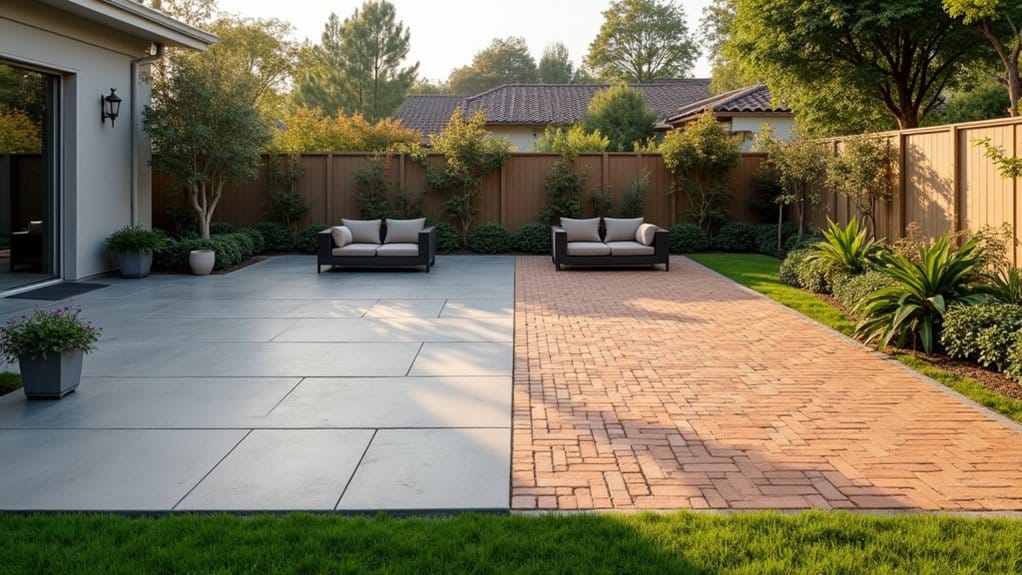
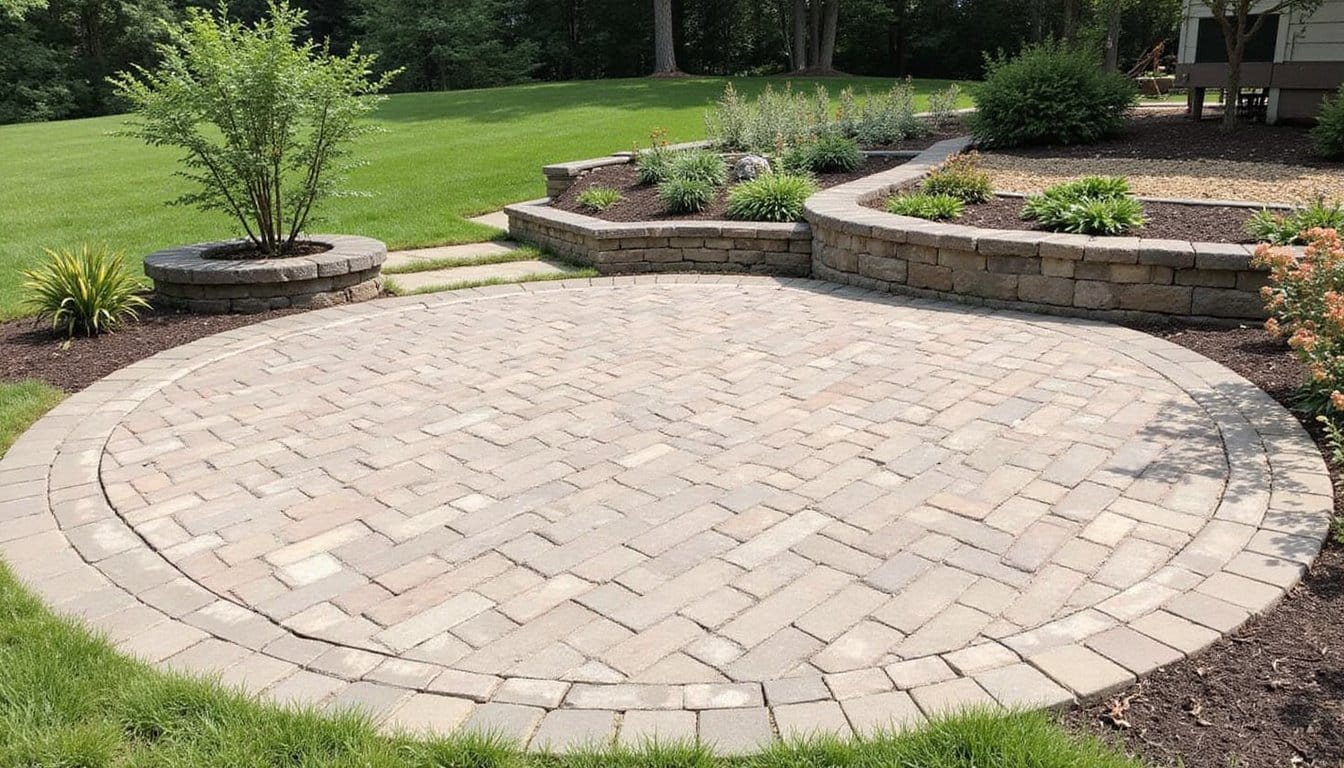
When you’re comparing a concrete slab to a paver patio, three differences stand out. First, pavers last 30 to 50 years because they flex with ground movement, while concrete cracks within 25. Second, pavers cost more upfront ($7, $13/sq. ft. vs. $3, $5), but you’ll avoid costly resurfacing cycles. Third, pavers offer geometric patterns, textures, and natural stone aesthetics concrete can’t replicate. Each difference carries site-specific details worth exploring below.
Why Paver Patios Outlast Concrete by Decades
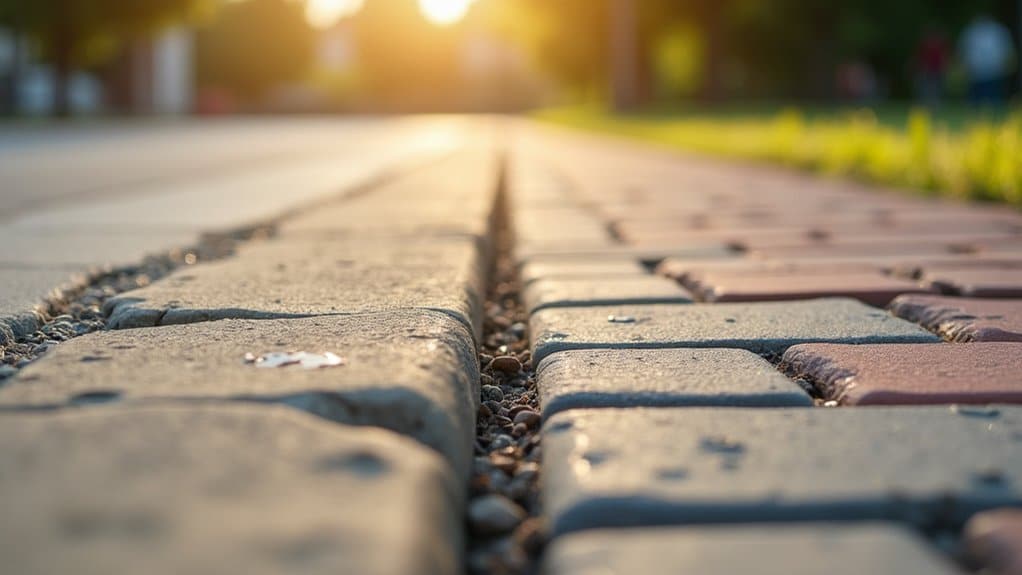
When you’re weighing a concrete vs. paver patio, longevity often tips the decision. Well-installed pavers endure 30 to 50 years, while concrete slabs typically reach 25 years before requiring major intervention. Individual paver units flex with ground movement, preventing the fractures that plague rigid concrete slabs during freeze-thaw cycles and soil shifts.
Your site’s resistance to environmental factors** matters considerably**. Pavers handle moisture, salt exposure, and temperature fluctuations without surface degradation. Their joints promote drainage, reducing erosion risk on sloped or unstable terrain. Their permeable design also reduces runoff, promoting environmental sustainability in your outdoor space.
When evaluating the cost of installation and maintenance, consider that damaged pavers replace individually, preserving your patio’s structure without full-slab demolition. Concrete demands ongoing sealing and crack filling, and neglected damage escalates into costly replacements far sooner.
Total Cost Breakdown: Pavers vs. Concrete Over Time
Concrete’s 10, 20 year lifespan introduces cracking, patchy repairs, and eventual full replacement. Your long term maintenance cost compounds with each repair cycle. Pavers deliver 50+ years of service, and you’ll replace individual units rather than entire sections. Resurfacing concrete costs $3 to $7 per square foot, replacing only the top layer before deeper damage demands full demolition.
Factor in labor differentials: concrete runs $3, $5 per square foot for installation versus $7, $13 for pavers. However, pavers generate stronger ROI through durability and property value increases. The higher initial investment offsets concrete’s recurring replacement expenses within two decades.
Paver Styles and Colors That Concrete Can’t Match
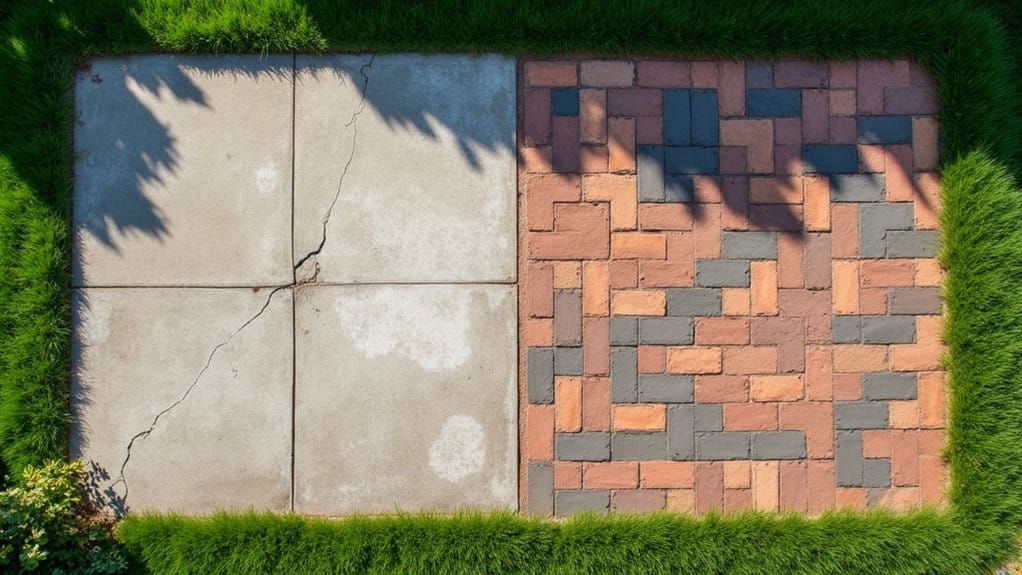
Beyond cost and longevity, pavers separate themselves from poured concrete through sheer design range. You’ll access natural stone aesthetics through travertine, cobblestone, and cut ashlar that stamped concrete can only approximate. Customized designs emerge when you combine layout geometry with material texture.
| Category | Pattern Options | Best Applications |
|---|---|---|
| Geometric | Herringbone, stack bond, checkerboard | High-traffic zones, modern patios |
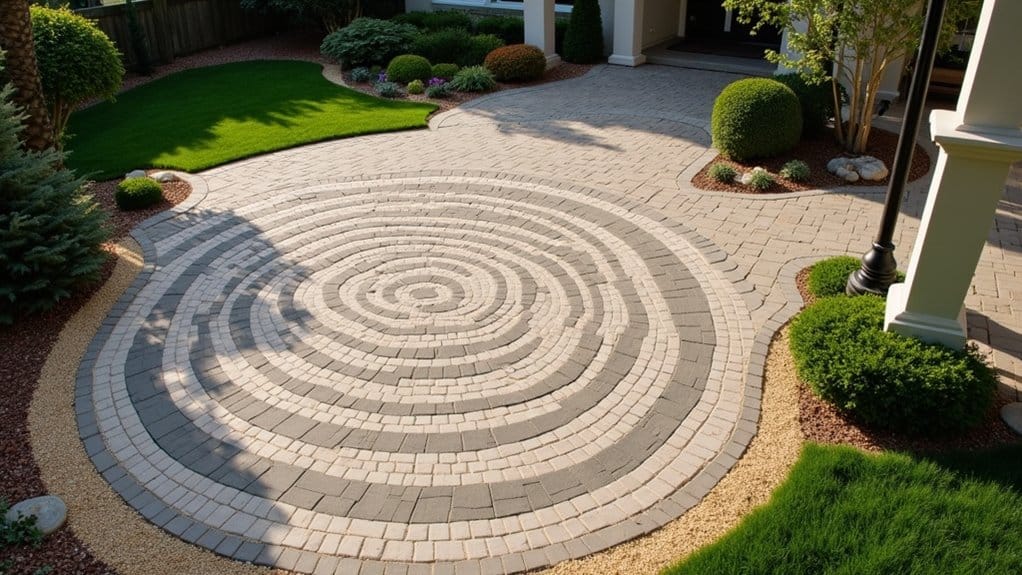
| Radiating | Circular, fan, semi-circular | Focal points, curved landscapes |
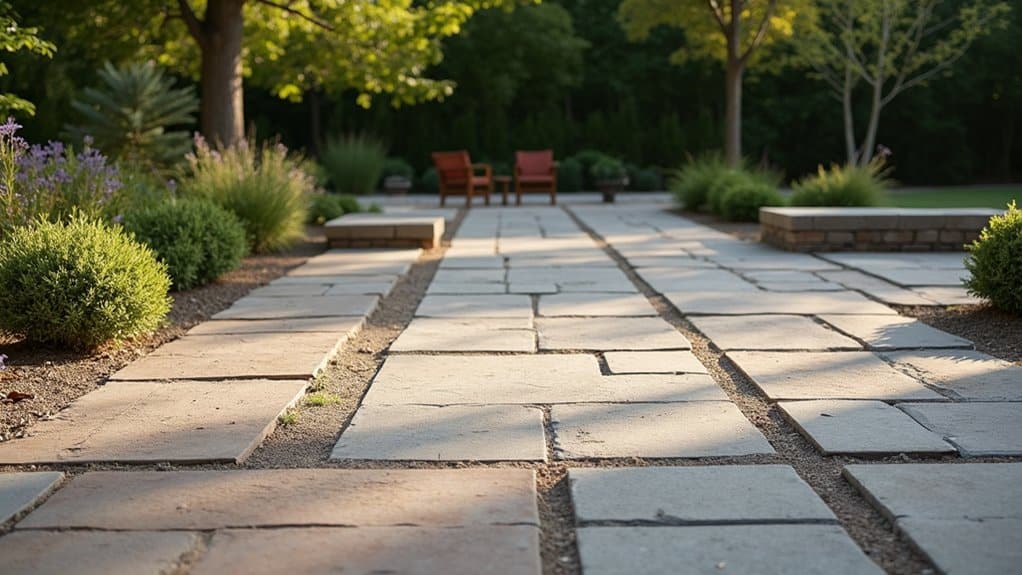
| Textured | Barn plank, brick running bond, porcelain | Colonial, farmhouse, Mediterranean styles |
You can pair Versailles interlocking repeats with travertine’s earthtones or lay cobblestone in herringbone for Tudor Revival authenticity, combinations that poured concrete’s surface treatments can’t replicate at this level of dimensional detail. Modular paver patterns also visually widen confined spaces, making patios and walkways appear larger, cleaner, and more connected through uniform alignment and reduced joint lines.
Frequently Asked Questions
Can I Install Pavers Over My Existing Concrete Patio?
Yes, you can install pavers directly over your existing concrete patio. First, assess your existing concrete condition, it must be structurally sound without major cracks or deterioration. Proper preparation steps include thoroughly cleaning the surface, ensuring adequate drainage, and applying a leveled bedding layer of coarse sand or mortar. You’ll choose between sand bed, mortar, or adhesive methods based on your site’s traffic demands, drainage needs, and desired design outcome.
How Do Pavers Perform in Freeze-Thaw Cycles Compared to Concrete?
Pavers outperform concrete in freeze-thaw cycles because their modular joints absorb expansion and contraction without cracking. You’ll find concrete’s rigid structure increases frost heave susceptibility, often causing uneven surface settlement across entire slabs. Pavers distribute stress across individual units, localizing any damage for easy replacement. Their permeable joints drain moisture effectively, reducing ice formation risk, while achieving 8,000+ PSI strength, roughly double concrete’s rating, ensuring superior long-term durability in cold-climate installations.
Are Pavers Safer Than Concrete When Wet or Slippery?
Yes, pavers deliver increased traction over concrete in wet conditions thanks to their textured surface profiles and permeable joint systems that channel water away rather than allowing it to pool. You’ll experience a reduced slip hazard around pool decks, patios, and walkways where moisture exposure is constant. Stamped concrete, by contrast, becomes dangerously slick when wet. For site-sensitive applications, pavers give you measurably superior wet-weather safety performance.
How Long Does a Typical Paver Patio Installation Take?
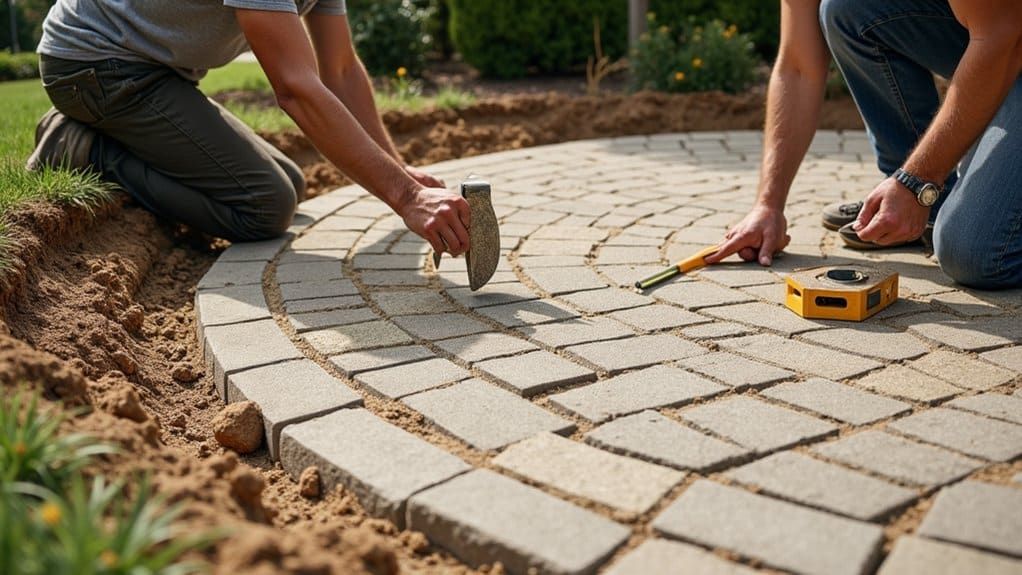
You’ll typically spend 4, 7 days on a complete paver patio installation. Paver patio installation time varies directly with your project’s square footage, design complexity, and site conditions, a straightforward 300 sq ft layout takes 3, 5 days, while intricate patterns or unstable subgrades extend your schedule considerably. Expect a labor intensive installation process spanning excavation, base compaction, paver placement, and joint sanding, with each phase demanding precise grading and material-specific handling techniques.
Do Pavers Stay Cooler Than Concrete in Direct Sunlight?
Yes, pavers generally stay cooler than concrete due to fundamental thermal mass differences between the materials. You’ll find travertine and natural stone surfaces measure 17-22 degrees cooler than concrete in direct sunlight, thanks to superior heat absorption properties and porous composition that facilitates heat dissipation. Light-colored selections amplify this advantage, while joint gaps promote airflow beneath the surface. You’re designing a noticeably more comfortable barefoot experience for pool decks and outdoor living zones.