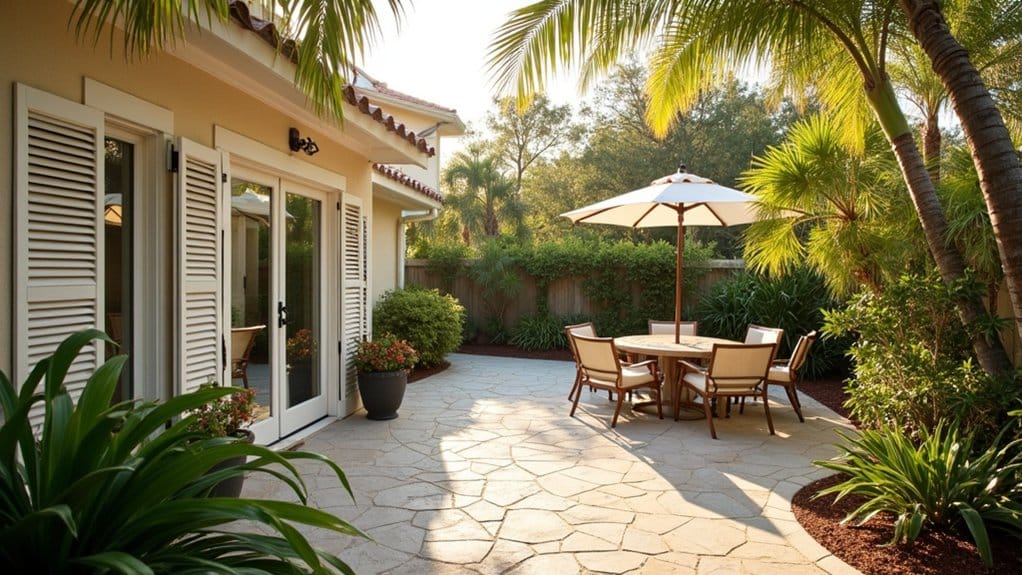
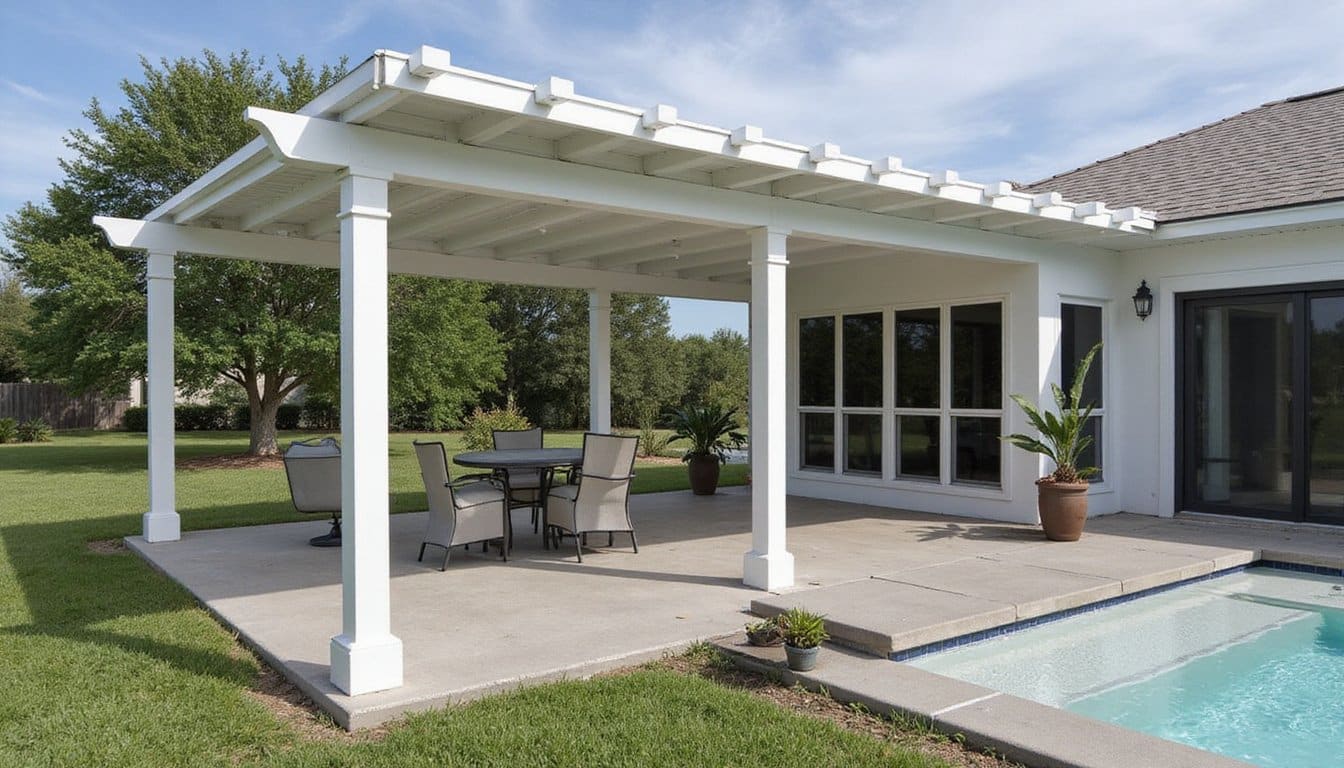
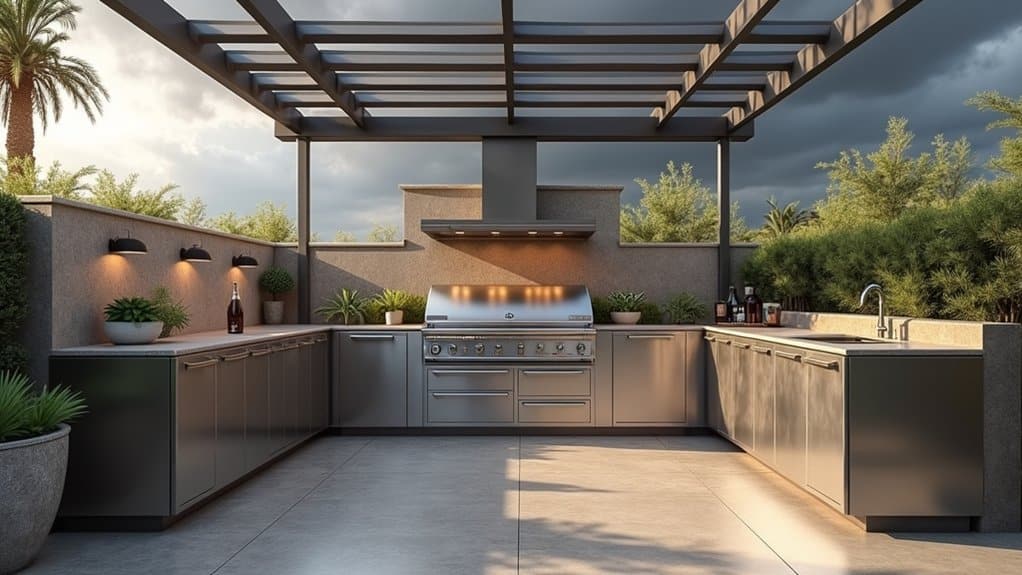
You’ll typically budget between $2,000 and $12,000 for most residential pergolas, with material choice driving outdoor pergola costs substantially. Aluminum offers the best long-term value at $15, $30 per square foot, while sustainable options like cedar run $25, $50. Don’t forget installation labor adds $10, $20 per square foot. Factor in an extra 15, 20% for site prep, permits, and design changes. Below, you’ll find detailed breakdowns to help you plan your perfect outdoor structure.
What Does the Average Pergola Cost?
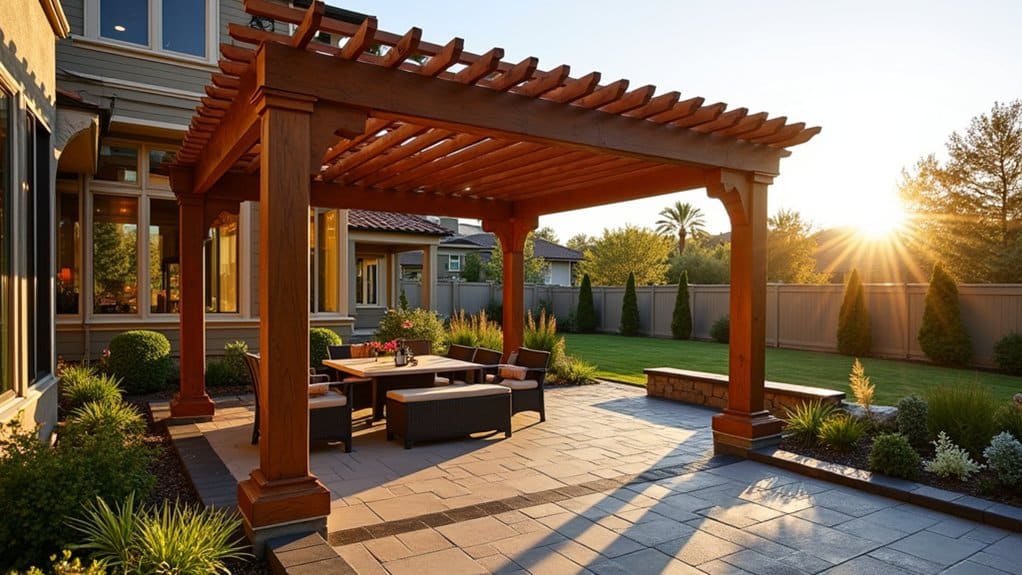
When you’re planning an outdoor pergola, material costs form the foundation of your budget. Wood pergolas run $35-$60 per square foot, while aluminum offers a more sustainable option at $15-$30 per square foot. Vinyl falls between at $20-$40 per square foot.
Material choice drives your pergola budget, wood costs the most, aluminum offers the best value, and vinyl lands in between.
For a standard 12×16-foot installation, you’ll typically invest around $8,848 for wood construction. Budget friendly pergola kits start at $4,662 for standard models, making them accessible entry points for most homeowners. Pergola kits are mass-produced and quicker to obtain, making them ideal for DIY installation.
Custom pergola designs command premium pricing, especially motorized aluminum systems ranging $25,000-$50,000. However, mid-range options like the Sundream S3 Pergola ($5,809-$8,300) balance quality with affordability. Keep in mind that accessories like lighting, curtains, and heating elements can add $200-$3,000 to your total investment. Manual louvered pergola models start at $9,999, providing an entry point into motorized outdoor living solutions.
Don’t forget installation labor adds $10-$20 per square foot, with professional services totaling $1,500-$5,000 depending on complexity and site conditions.
Pergola Costs by Size and Square Footage
Understanding material costs gives you a baseline, but your pergola’s footprint ultimately determines your final investment.
Cost Breakdown by Size
A 12×12 pergola (144 square feet) runs $1,450, $5,750 for prefab installations or $4,300, $9,400 with custom design options. Moving to 12×14 dimensions (168 square feet), expect $1,700, $2,700 prefab or $5,000, $10,900 custom-built.
For larger outdoor rooms, a 12×20 structure (240 square feet) costs $2,400, $9,600 prefab, while 16×16 configurations (256 square feet) range $2,550, $10,250. Your material selection profoundly impacts these figures, wood options typically add $20, $40 per square foot. Premium materials like redwood or steel can push costs to $40, $70 per square foot, significantly affecting your total budget.
At 20×20 (400 square feet), you’re investing $4,000, $16,000 for prefab or $12,000, $26,000 custom. Industry-wide, pergolas average $10, $65 per square foot, with labor adding $50, $120 hourly for professional installation. A typical 10×12 foot pergola costs $6,000 to $10,000, providing a helpful benchmark for mid-sized projects. For a 129 square foot wood pergola, custom site-built construction with cedar or redwood typically ranges from $10,199.90 to $12,537.80, including basic labor under favorable site conditions.
How to Set a Realistic Pergola Budget
Several key factors determine whether your pergola budget aligns with reality or sets you up for costly surprises. Start by defining your size requirements and material preferences, since these drive costs from $2,000 for basic DIY kits to $15,000+ for custom builds.
When estimating longterm expenses, factor in installation fees ($1,000 to $2,000), site preparation costs, and permit requirements. Don’t overlook terrain challenges, sloped sites substantially increase labor expenses. Flat and smaller areas are typically less expensive than sloped or uneven spacious yards.
Budgeting maintenance needs proves equally critical. Cheaper wood demands regular sealing, while vinyl and aluminum offer sustainability-minded durability with minimal upkeep. Calculate five-year maintenance costs alongside your initial investment.
Reserve 15-20% beyond your base estimate for accessories, unexpected site conditions, and design refinements. This buffer guarantees your pergola integrates seamlessly into your landscape without financial strain. A well-planned pergola investment can add value and enhance curb appeal of your home, making the careful budgeting worthwhile. Most homeowners find their projects fall between $4,000 and $7,000, providing a realistic benchmark for your planning.
Wood Pergola Costs: Pine, Cedar, Redwood, and Teak
Wood remains the most popular pergola material because it offers natural aesthetics that blend seamlessly into outdoor landscapes. Your budget determines which species fits your project, with costs ranging from $20 per square foot for pressure-treated pine to $100 for premium teak.
Consider these factors when selecting your wood type:
- Pine ($20, $40/sq ft) requires regular wood staining considerations to maintain weather resistance
- Cedar and redwood ($25, $50/sq ft) provide natural rot resistance with custom design options
- Teak ($55, $100/sq ft) delivers maximum durability for harsh climates
A 10×12 pine pergola runs approximately $1,700, while cedar costs $2,000 for identical dimensions. This size represents the smallest most homeowners want, generally used for sitting areas with multiple chairs. Redwood and teak installations command premium pricing but offer superior longevity and sustainable performance. While wood offers upfront savings, keep in mind that these materials require more maintenance over time compared to aluminum alternatives. Wood pergolas typically cost $4,000 to $15,000 overall, placing them within the mid-range of patio covering options.
Aluminum, Vinyl, and Steel Pergola Costs Compared
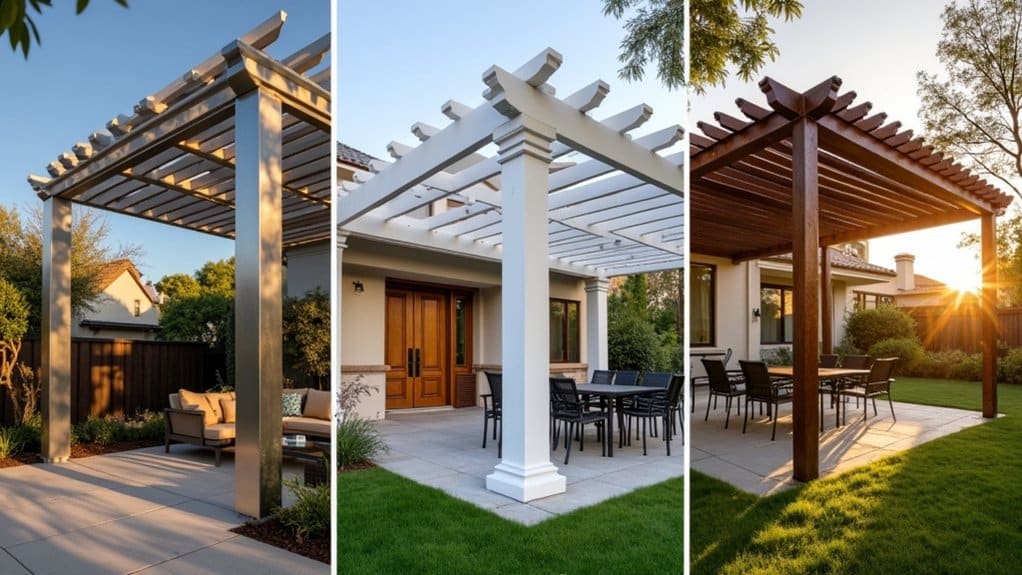
When you’re comparing aluminum, vinyl, and steel pergolas, you’ll find materials ranging from $10 to $70 per square foot, with aluminum and vinyl offering the most budget-friendly options at $10 to $30 per square foot while steel commands $30 to $70 per square foot. Each material delivers distinct longevity benefits, steel provides unmatched structural strength for heavy plantings or solar panel integration, while aluminum and vinyl require minimal maintenance and resist corrosion without chemical treatments. High-grade aluminum is specifically engineered to resist rust and the effects of salt and humidity, making it ideal for coastal environments. Aluminum options like Alumawood or Weatherwood pergola kits cost $12.77 to $18.04 per square foot for DIY installation, making them accessible for budget-conscious homeowners. Your choice ultimately balances upfront investment against long-term durability, with installed costs spanning $25 to $60 per square foot for aluminum and vinyl prefabs versus higher totals for steel’s robust weather resistance.
Material Price Breakdown
The framework of your pergola determines both its upfront cost and long-term performance in your outdoor space.
When evaluating pricing margins across materials, you’ll find significant variation. Material quality considerations directly impact what you’ll spend per square foot:
- Aluminum, At $10 to $30 per square foot, this lightweight option delivers durability without straining your budget, making sustainable outdoor living accessible.
- Vinyl, Ranging from $10 to $30 per square foot for materials, vinyl matches aluminum’s affordability while offering low-maintenance appeal for busy homeowners.
- Steel, Commanding $30 to $70 per square foot, steel doubles aluminum’s baseline cost but provides unmatched structural integrity for custom, site-specific designs.
Your material choice shapes how seamlessly your pergola integrates with existing landscape architecture and environmental conditions.
Durability Versus Cost
Choosing between aluminum, vinyl, and steel pergolas requires balancing your initial budget against decades of maintenance costs and replacement cycles. When you calculate total cost of ownership, aluminum’s premium price delivers superior value through its 20-30 year lifespan and minimal upkeep demands.
| Material | Lifespan | Long Term Material Costs |
|---|---|---|
| Aluminum | 20-30+ years | Lowest (minimal maintenance) |
| Vinyl | 10-20 years | Moderate (UV damage repairs) |
| Steel | 5-15 years | Highest (rust prevention) |
Steel’s lower upfront cost deceives many buyers, you’ll spend considerably more on corrosion treatments and earlier replacements. Coastal or humid regions may accelerate steel’s deterioration as corrosive forces hasten the onset of rust. Vinyl offers middle-ground affordability but succumbs to UV degradation in sunny climates. Aluminum pergolas require only a thorough wash every 6, 12 months using mild soap and water, eliminating the ongoing expenses associated with other materials. For sustainable, site-integrated design that respects your long-term budget, aluminum’s recyclability and durability make it the economically sound choice.
Which Pergola Roof Styles Cost the Most?
Your pergola roof style greatly impacts both your budget and how seamlessly the structure integrates with your outdoor living space. Retractable canopy systems offer the most budget-friendly option at $4 to $10 per square foot, while louvered roofs range from $45 to $175 per square foot depending on whether you choose manual, motorized, or smart-enabled controls. Motorized smart louvers represent the premium tier, adding app connectivity and sensors that let you adapt to weather conditions while reducing energy demands on your home.
Retractable Awning Expenses
Retractable awning systems represent one of the most versatile pergola roof options you’ll encounter, with residential models spanning $350 to $6,000 depending on size, mechanism, and material choices. Your average retractable awning quality determines longevity and performance, with motorized versions costing $1,500 to $8,000 compared to manual options at $1,200 to $4,500.
When evaluating retractable awning brand reputation, consider these investment tiers:
- SunSetter models range $800 to $7,000 with 5-year warranties for reliable coverage
- Sunesta options cost $700 to $4,000 featuring 10-year warranties and enhanced durability
- Motorized upgrades add $1,000 to $3,000 but reduce fabric wear through consistent tension
Professional installation runs $60 to $100 hourly, while sustainable all-weather fabrics add $300 to $2,000. Budget $15 to $30 per square foot for complete site integration.
Louvered Roof Pricing
Louvered roof systems command premium pricing among pergola coverings, with installed costs ranging $60 to $160 per square foot depending on material quality and automation features. Roll-formed aluminum louvers start around $40 per square foot, while extruded aluminum options reach $150 per square foot due to their superior structural support system and durability.
Your material choice greatly impacts long-term value. Extruded louvers offer enhanced strength and system customizability, justifying their higher cost for sustainable outdoor living spaces. A standard 12’x12′ installation ranges from $8,640 to $23,040 based on specifications.
Premium brands like Struxure and Equinox exceed $180 per square foot installed, integrating motorized controls and weather-responsive technology. Budget-conscious DIY kits start at $3,499, though professional installation typically begins at $35,000 for fully loaded configurations.
Motorized Canopy Costs
Motorized canopy systems offer flexible shade control at price points well below louvered alternatives, with retractable fabric options running $500 to $1,750 installed or roughly $4 to $10 per square foot. You’ll find motorized retractable awnings cost $1,000 to $6,000 for home-attached pergolas, with most installations averaging $1,500 to $3,500.
Consider these factors when evaluating your investment:
- Motorized canopy lifespan extends 8-15 years with quality UV-resistant fabrics that complement your outdoor aesthetic
- Motorized pergola maintenance remains minimal, periodic fabric cleaning and motor lubrication keep systems running smoothly
- Eco-conscious operation reduces energy consumption by providing on-demand shade without permanent structural commitments
Fabric and synthetic materials range $7 to $40 per square foot for awning-style installations, giving you design flexibility to match your home’s architectural character.
Pergola Installation Costs: DIY vs. Hiring a Pro
For a 12’x12′ pergola, expect $1,450 to $5,750 for a DIY kit installation versus $4,300 to $9,400 for custom professional work, roughly two to three times the investment.
Lighting, Canopies, and Other Pergola Add-On Costs
Three essential add-ons transform a basic pergola into a fully functional outdoor living space: lighting, canopies, and climate control features. When budgeting for add on accessory costs, you’ll find hardwired lighting options range from $100 to $200 per fixture, while solar alternatives cost $50 to $200, reducing long-term energy consumption by up to 80% compared to halogen.
Consider these design-enhancing upgrades:
- String lights ($160, $600 for two strands) create intimate ambiance with commercial-grade LEDs lasting 10 years
- Uplights ($100, $400 each) highlight architectural details while integrating seamlessly with landscape design
- Dimmer systems ($100, $500) offer customizable atmosphere for sustainable energy management
Basic pergola lighting packages start at $1,400 for 10×10 structures, scaling to $3,500 for 12×20 configurations.
Hidden Pergola Costs: Permits, Site Prep, and Electrical
Beyond the aesthetic upgrades that elevate your pergola’s ambiance, you’ll need to account for permit fees, site preparation, and electrical work, costs that often catch homeowners off guard.
Hidden costs like permits, site prep, and electrical work can add thousands to your pergola project budget.
Building permits for pergolas range from $150 to over $1,200 based on project valuation, while plan check fees add $537 to $637. Don’t overlook the $254.80 final inspection fee. Site preparation runs $5,000 to $25,000 depending on terrain complexity and drainage needs.
For integrated lighting, residential electric permits cost $254.80, with utility connections ranging $5,000 to $20,000 for substantial installations. Factor in processing fees ($160) and strong motion fees ($0.72).
Before breaking ground, research local HOA regulations that may impose additional requirements. Schedule expert consultations early, they’ll help you navigate permit complexities while ensuring your pergola design integrates seamlessly with your landscape’s sustainability goals.
Are Motorized Pergolas Worth $25,000 or More?
Spending $25,000 or more on a motorized pergola demands careful consideration of what you’re actually getting for that premium investment. At this price point, you’re accessing high-grade aluminum construction lasting 15-20 years, integrated smart sensors, and seamless site integration that complements your home’s architecture.
When justifying high end costs, consider these value added premium features:
- Automated rain and wind sensors protect your outdoor space without manual intervention
- Mobile app control lets you adjust louvers from anywhere, maximizing daily usability
- Integrated lighting systems extend evening functionality while reducing additional installation costs
Custom models between $25,000-$50,000 deliver year-round comfort through superior weather protection and durability. You’re investing in a structure that responds intelligently to environmental conditions while enhancing your property’s sustainable outdoor living potential.
Frequently Asked Questions
How Long Does a Typical Pergola Last Before Needing Replacement?
A typical pergola lasts 10-50 years depending on your pergola construction materials and care routine. You’ll get 10-20 years from wood, while aluminum and vinyl push beyond 20-30 years. Your pergola maintenance requirements directly impact longevity, annual sealing, regular cleaning, and timely staining can extend lifespan extensively. When you choose sustainably sourced cedar and integrate your design with site-specific climate conditions, you’re investing in a structure that endures beautifully for decades.
Do Pergolas Increase Home Resale Value?
Yes, pergolas can boost home value by an estimated 15% when properly integrated into your landscape design. You’ll improve curb appeal while creating functional outdoor living space that today’s buyers actively seek. Custom wood structures typically deliver the highest perceived value, though sustainable vinyl options require minimal maintenance, preserving their worth over time. When you select materials that complement your home’s architecture and site conditions, you’ll maximize your resale return.
What Time of Year Is Cheapest to Install a Pergola?
You’ll typically find the best seasonal discounts during late fall and winter when contractors have lighter schedules. Off-season installation, usually November through February, often means lower labor rates and faster project timelines since demand decreases considerably. By planning your pergola project during these quieter months, you can negotiate better pricing while still selecting sustainable materials like responsibly sourced cedar or reclaimed wood that’ll integrate seamlessly with your outdoor living space come spring.
Can Pergolas Withstand Hurricanes or Heavy Snow Loads?
You can design pergolas to withstand hurricanes and heavy snow when you prioritize structural integrity and weather resistant materials. Aluminum frames resist 140 mph winds, while fiberglass composites handle 70 psf snow loads. You’ll need 36-48 inch deep post footings and diagonal bracing for extreme conditions. Consider retractable roofs that reduce wind load by 40% and auto-close during storms, a sustainable choice that integrates protection with your site’s natural elements.
Do Homeowners Insurance Policies Cover Pergola Damage?
Your homeowners insurance typically covers pergola damage from windstorms, hail, or falling objects, though policy coverage limits vary based on whether your structure’s attached or freestanding. You’ll need to meet damage assessment requirements by documenting everything with photos and contractor estimates. Consider sustainable materials that withstand your climate, they’ll integrate better with your site’s design while potentially reducing claims. Exclude floods and maintenance-related issues from your expectations, and review endorsements for enhanced protection.