If your pool deck shows widening cracks, water pooling, or rough textures that signal surface failure, you’ve got several resurfacing systems to evaluate. Acrylic coatings offer UV-resistant coverage at $5, $10 per square foot, spray knockdown texture delivers cool-surface slip resistance, rubberized overlays provide 20+ years of ADA-compliant durability, and epoxy creates a seamless chemical-resistant barrier lasting 10, 15 years. Each pool deck resurfacing option installs over your existing substrate without demolition. Below, you’ll find the specific failure modes each system addresses.
Signs Your Pool Deck Is Ready for Resurfacing
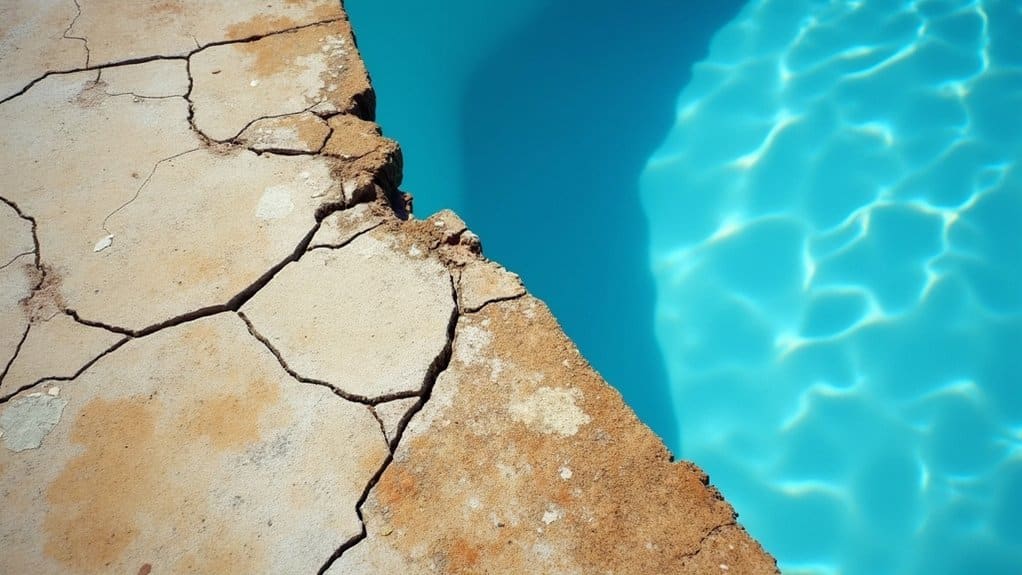
Over time, your pool deck telegraphs its distress through unmistakable warning signs, and catching them early saves you from costly structural repairs down the line. Visible cracks that widen beyond hairline control joints signal subsurface shifting, while water infiltration compounds the damage. Discoloration and fading indicate your protective coatings have failed under UV exposure, leaving materials vulnerable. Rough textures, found in up to 78% of pools needing resurfacing, create injury risks and accelerate breakdown.
Gradual deterioration manifests as pooling water from warped materials, loose fasteners, and soft spots from mold penetration. These issues are often accelerated by freezing and thawing cycles that repeatedly stress the deck’s structural integrity throughout colder seasons. When you’re facing continuous maintenance requirements, patching cracks repeatedly, addressing splintered boards, managing slip hazards, you’ve crossed the threshold from spot repairs into full resurfacing territory.
Acrylic Coatings for Budget-Friendly Pool Deck Resurfacing
Acrylic coatings give you UV-resistant color options through built-in absorbers and stabilizers that prevent photo-oxidation, keeping your pool deck’s finish vibrant for 3, 5 years without fading. With a high glass conversion temperature of 105°C and reflective pigment technology, these coatings stay cool underfoot, so you can walk barefoot even on sun-exposed surfaces. You’ll find 16 standard colors and custom acid-stained finishes starting at $5, $10 per square foot, making acrylic a cost-effective substitute to natural stone at $20, $30 per square foot. Because the coating moves along with the concrete during expansion and contraction cycles, it actively prevents crack formation and protects the underlying surface from chipping and crumbling over time.
UV-Resistant Color Options
| Product | Color Options | UV Performance |
|---|---|---|
| E-Z Pooldeck® | 6 standard colors | Resists lifting and fading |
| Doheny’s | Creekstone, Desert Sun, Sand Valley, Champagne | Colorfast, UV resilient |
| H&C Acryla-Deck | Extra-white and deep bases for custom tinting | Reduces surface temp up to 20°F |
You should prioritize products offering both UV stabilization and broad color ranges. H&C’s custom-tint bases give you maximum flexibility, while Doheny’s preset options simplify selection without sacrificing UV durability. E-Z Pooldeck® is an epoxy fortified acrylic coating that also seals pool decks from salt water deterioration and protects from spalling, making it a strong choice for aging pool environments.
Cool Barefoot Comfort
These formulations also achieve resilient heat reduction, lowering surface temperatures by up to 38% compared to uncoated concrete. This prevents burn risks and eliminates the discomfort that deters midday pool use in hot climates. You won’t need footwear to lounge or walk comfortably under direct sun exposure. At $5, $10 per square foot, you’re getting thermal management and safety compliance without exceeding a modest resurfacing budget.
Spray Knockdown Texture for a Cool, Slip-Resistant Deck
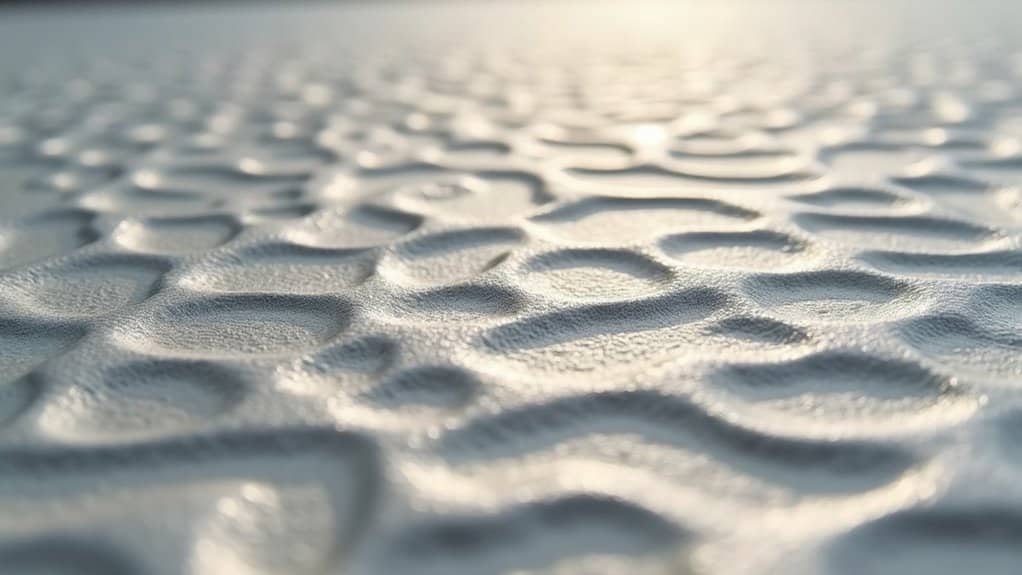
Among the most effective pool deck resurfacing options available, spray knockdown texture stands out as a polymer-based coating that delivers cool-surface performance, slip resistance, and long-term durability in a single application. You’ll benefit from its heat-reflective properties, which keep surfaces cooler than concrete, brick pavers, or tiles under prolonged sun exposure. The lightly textured finish provides consistent traction, reducing slip risks in wet environments without feeling abrasive underfoot.
Its non-porous composition seals concrete against water, chemicals, mold, and UV damage while resisting cracking and fading for 10, 15 years. The seamless application process hides minor surface imperfections, and customizable aesthetics replicate stone or tile patterns. You’ll need only periodic resealing and light cleaning to maintain peak performance.
Rubberized Pool Deck Resurfacing for Families
Installation takes 1-2 days over your existing deck. The flexible, UV-resistant material won’t chip, crack, or peel through freeze-thaw cycles, delivering 20+ years of performance. For multigenerational family safety, rubberized resurfacing meets ADA compliance standards while requiring only soap-and-water maintenance.
Epoxy Coatings for Chlorine-Heavy Pool Decks
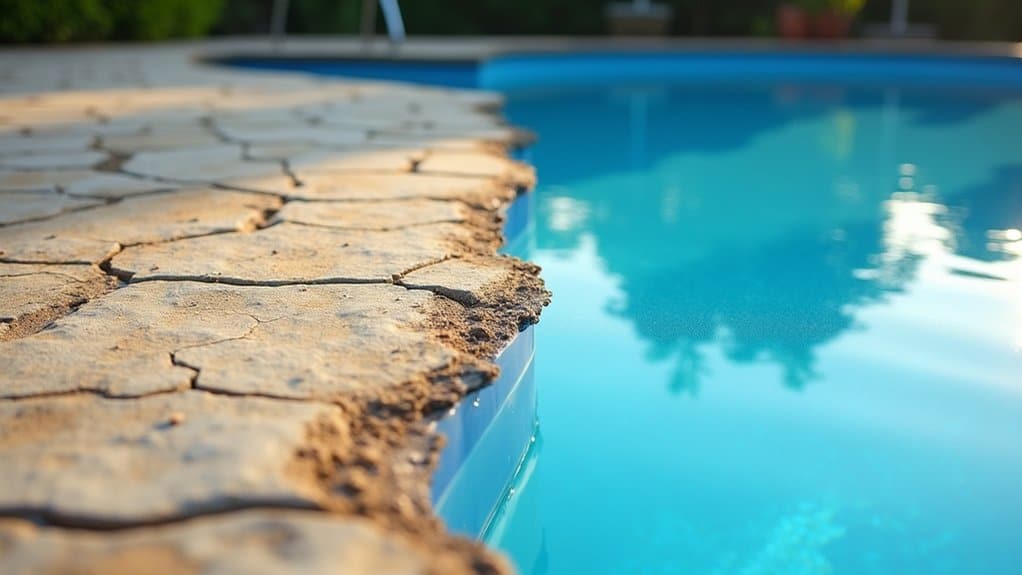
When your pool deck endures constant chlorine exposure, epoxy coatings deliver a seamless, chemical-resistant barrier that prevents discoloration, staining, and subsurface penetration. You’ll get a durable finish engineered to withstand chlorinated splashes, saltwater contact, and routine chemical maintenance without corroding or degrading over its 10, 15 year lifespan. Epoxy systems also offer customizable finishes, including slip-resistant additives and UV-stable topcoats, so you’re not sacrificing safety or aesthetics for chemical protection.
Chemical-Resistant Seamless Protection
Expect 10, 15 years of performance with proper maintenance, double the lifespan of acrylic alternatives. After a 24, 48 hour cure, you’ll have a stain-resistant, glossy surface that cleans effortlessly.
Chlorine Exposure Durability
That 10, 15 year lifespan holds true under standard conditions, but chlorine-heavy pool decks introduce a more aggressive chemical environment that directly impacts epoxy coating longevity. When chlorine exceeds 5 ppm, you’ll see lifespan drop from five years to two. ASTM testing confirms 20, 30% tensile strength loss after 12 months of continuous exposure, while ISO 2812 immersion results show accelerated blistering.
Effective chlorine mitigation strategies include specifying chlorine-resistant epoxy blends or polyurethane topcoats certified under ASTM D543. You should apply UV-resistant topcoats to prevent yellowing from combined sunlight and chlorine exposure. For deterioration prevention measures, inspect quarterly for chalking, discoloration, and micro-cracks. Reseal every 18, 24 months and guarantee surface preparation meets CSP 4, 5 profiles using bush hammer tools to maximize coating adhesion.
Customizable Tough Finishes
| Feature | Options | Benefit |
|---|---|---|
| Color Profiles | Solid, multi-tone, exterior-matched | Seamless home integration |
| Flake Finishes | Decorative aggregate patterns | Timeless design appeal |
| Surface Texture | Polycarbonate anti-slip additive | Wet-zone slip resistance |
| UV Topcoat | Fade-resistant clear seal | Color retention under exposure |
| Stone Simulation | Natural stone appearance layers | Premium look, epoxy durability |
You’ll configure each parameter independently, selecting flake density, color code, and slip-resistance grade, then deploy a single monolithic coat that resists chlorine, UV degradation, and heavy foot traffic simultaneously.
Stamped Concrete Overlays for a High-End Look
Five key advantages make stamped concrete overlays one of the most practical resurfacing solutions for pool decks: durability, design versatility, low maintenance, slip resistance, and cost-effectiveness.
- Durability: UV-resistant pigments and high-quality composites withstand extreme heat, freezing temps, and heavy rain without cracking or fading.
- Design versatility: Customized design patterns replicate stone, slate, brick, or cobblestone textures at a fraction of natural material costs.
- Low maintenance: Non-porous sealed surfaces resist mold, mildew, and stains, no regular refinishing required.
- Slip resistance: Non-slip sealers with textured additives like Sharkgrip deliver durable slip resistant finishes for wet poolside conditions.
- Cost-effectiveness: You’ll pay 40, 70% more than brushed concrete but gain superior aesthetics, longevity, and reduced lifetime maintenance costs.
How to Choose the Right Pool Deck Resurfacing Option
Stamped concrete overlays deliver strong results, but they’re just one option in a broader resurfacing toolkit, and picking the right method depends on variables specific to your pool deck. Start by evaluating existing cracks, buckling, and substrate integrity. Use Dustless Blasting for prep, it eliminates silica dust hazards tied to grinding.
Next, match materials to exposure conditions. Cementitious coatings resist UV, chemicals, and abrasion. Pavers allow single-unit replacements, reducing long term maintenance needs. Spray textures create a consistent surface texture that’s cool and slip-resistant.
Factor in cost trajectory: deck paint runs cheap upfront but demands annual reapplication. Overlays average 35% less than full replacements. Weigh durability against budget, prioritize ASTM-compliant slip resistance, and you’ll lock in the right resurfacing solution.
Frequently Asked Questions
How Long Does Pool Deck Resurfacing Typically Take From Start to Finish?
You’ll typically complete pool deck resurfacing in 5, 10 days, spanning inspection, surface prep, coating application, and curing. Factors affecting project timeline include your pool’s size, surface condition, and chosen finish material, pebble coatings require longer cure cycles than standard plaster. Weather considerations for application are critical; rain or extreme temperatures can delay curing by 3, 5 days. You shouldn’t rush the process, proper adhesion and durability depend on each phase executing sequentially.
Can Pool Deck Resurfacing Be Done During Winter or Cold Weather?
You can resurface your pool deck in cold weather, but you’ll face potential weather-related challenges like freeze-thaw cycles that damage uncured coatings and moisture infiltration. Proper timing for resurfacing means scheduling application in fall, allowing polyurea coatings to fully cure before freezing temperatures arrive. You’ll want to apply polyurea with a polyaspartic topcoat, it remains flexible in winter, resists frost, and cures within 24 hours, unlike epoxy that’ll crack and become brittle.
How Soon After Resurfacing Can You Use the Pool Area?
You can walk on your resurfaced pool deck within 24 hours for light foot traffic. You’ll want to avoid placing furniture for 72 hours and prevent water contact during the initial curing period. For full pool usage, you should wait approximately one week, this guarantees proper pool safety precautions are met and permits pool water chemistry to stabilize without residual chemicals compromising the finish’s integrity or causing skin irritation.
Does Pool Deck Resurfacing Require a Professional or Allow DIY Installation?
You can tackle pool deck resurfacing as a DIY project, but the DIY skills required are substantial, you’ll need proficiency in etching, grinding, mixing, troweling, and sealing. For cost effective installation, you’ll save on labor but risk expensive rework if you misapply products. Small maintenance patches suit DIY approaches, while full resurfacing demands professional-grade equipment and climate-specific material knowledge. You’ll want to assess your technical competency honestly before committing.
How Many Years Does a Resurfaced Pool Deck Typically Last?
Your resurfaced pool deck typically lasts 5-20 years, depending on the material you’ve selected, acrylic coatings deliver 5-10 years, while polyaspartic systems achieve 15-20 years. Key factors affecting pool deck resurfacing lifespan include climate exposure, foot traffic intensity, and chemical contact from pool water. You’ll maximize durability through proper maintenance for extended pool deck lifespan: reseal every 1-5 years based on coating type, repair cracks immediately, and clean weekly using pH-balanced solutions.