If you’re weighing a built-in fire pit against a portable one, it comes down to budget, flexibility, and how long you’ll stay in your space. Portable units start under $100 and move wherever you need them. Built-in options range from $1,500 to $5,000+ but last decades and boost your home’s value. Your backyard’s size, fuel preference, and design goals all play a role, and each factor shapes the right call differently.
Built-In vs Portable Fire Pits: Key Differences
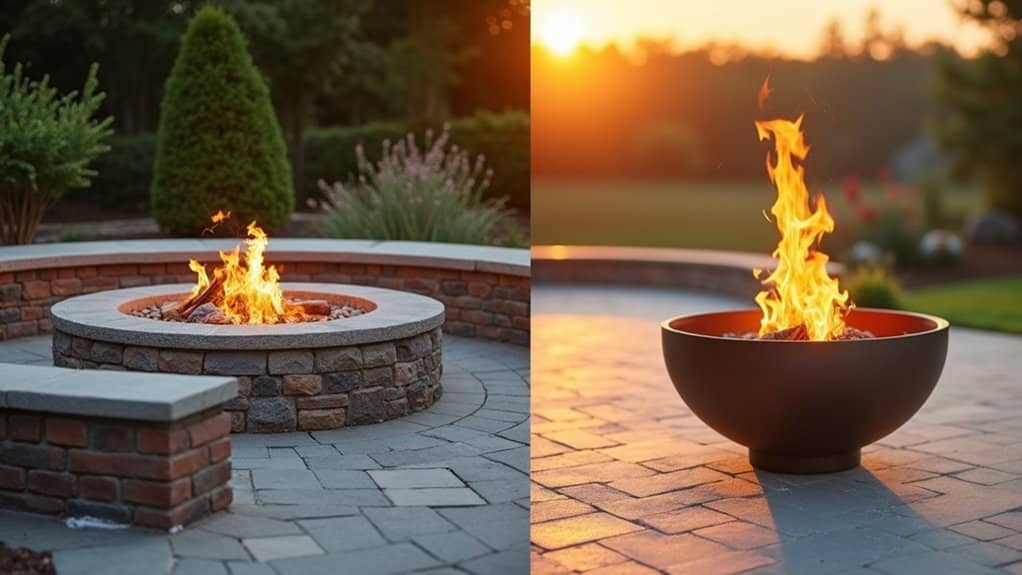
When you’re choosing between a built-in and portable fire pit, the core tradeoff comes down to permanence versus flexibility. A built-in fire pit anchors your yard with a fixed focal point that integrates with surrounding hardscape, seating walls, and patios. A portable unit, often weighing less than 75 pounds, lets you reposition freely across different zones.
Your fire pit installation type shapes everything from site prep to long-term maintenance. Built-in models require excavation, non-flammable liners, and professional labor. Portable options arrive ready to use with minimal assembly. Space and backyard layout matter here, fixed pits demand deliberate clearance and circulation planning, while portable designs adapt to existing arrangements without permanent space allocation. Heavier built-in gas models are often constructed from robust materials like glass-fiber reinforced concrete, ensuring lasting durability against the elements.
How Much Does Each Fire Pit Type Cost?
Cost separates built-in and portable fire pits more than any other factor. You’ll find portable options starting under $100, with mid-range models running $200, $800. A portable fire pit best suits budgets under $500 when you’re prioritizing flexibility over permanence.
A permanent fire pit demands more investment. Basic built-in projects start around $300, $2,500, while in-ground fire pit cost typically lands between $1,000, $3,000. Custom designs with premium materials can push past $10,000. Prefabricated fire pit kits offer a middle ground, typically ranging from $500 to $2,000 with styles that deliver a polished look without full custom pricing.
Fuel type shifts pricing considerably. Wood-burning setups run $300, $1,000 installed, while natural gas models reach $400, $3,000 once you factor in burner kits and gas line work. DIY builds can keep costs between $150, $1,500, but professional installation commonly starts at $2,000, $5,000 depending on materials, labor complexity, and surrounding hardscape integration.
What It Takes to Install a Built-In Fire Pit
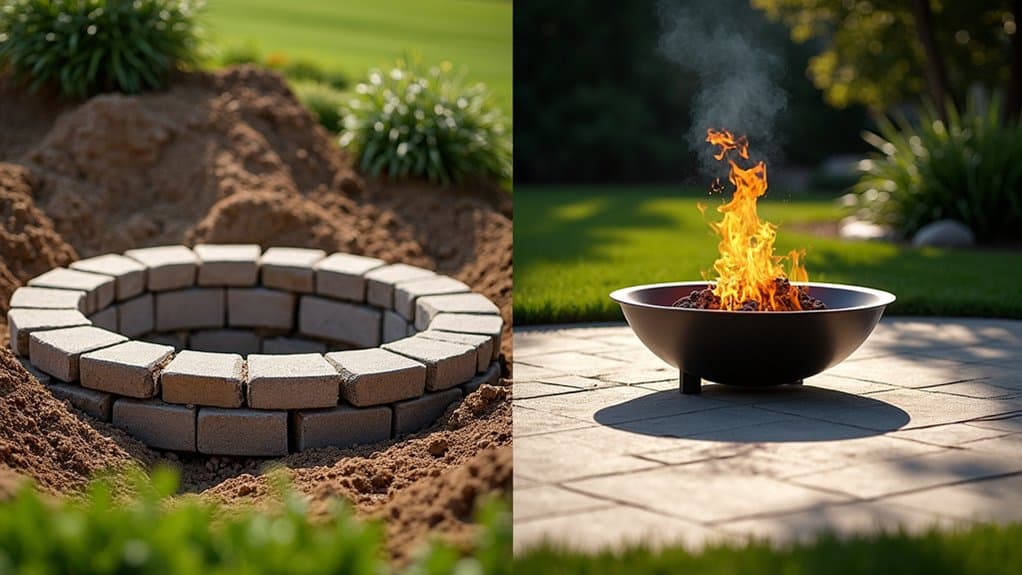
A built-in fire pit locks into your yard permanently, so the installation process demands more planning than dropping a portable unit on a patio. You’ll need to evaluate site conditions, base preparation, and how the structure ties into your existing hardscape. A masonry fire pit requires structural groundwork that simpler options don’t.
Professional help typically runs $60 to $125 per hour, with full installation totaling $250 to $4,000+ depending on complexity. Key factors that drive labor and installation scope include:
- Site grading and base preparation for stable footing
- Gas line routing if you’re choosing a gas-fueled system
- Permit acquisition, typically $100 to $500
- Patio integration, which can push costs to $1,500, $5,000
Budget for both materials and professional labor before breaking ground. If your yard isn’t even, leveling the ground alone can add $500 to $2,500 to your total project cost.
Wood, Propane, or Gas: Picking the Right Fuel
Once you’ve sorted out installation logistics, your next decision, fuel type, shapes how the fire pit performs, what it costs to run, and how much upkeep you’ll deal with season to season.
Wood delivers the classic crackling ambiance at the lowest fuel cost, but you’ll handle ash removal, smoke, and sparks after every burn. A propane fire pit offers cleaner combustion, quick ignition, and works well as a freestanding fire pit you can relocate without utility work. Natural gas connects to your home’s supply line, eliminating tank refills and providing steady fuel for frequent use, though upfront installation costs run higher.
Match your fuel choice to how often you’ll use the pit, your tolerance for maintenance, and whether portability or permanence drives your backyard layout. Always check local regulations before committing.
Which Fire Pit Works Best in a Small Backyard?
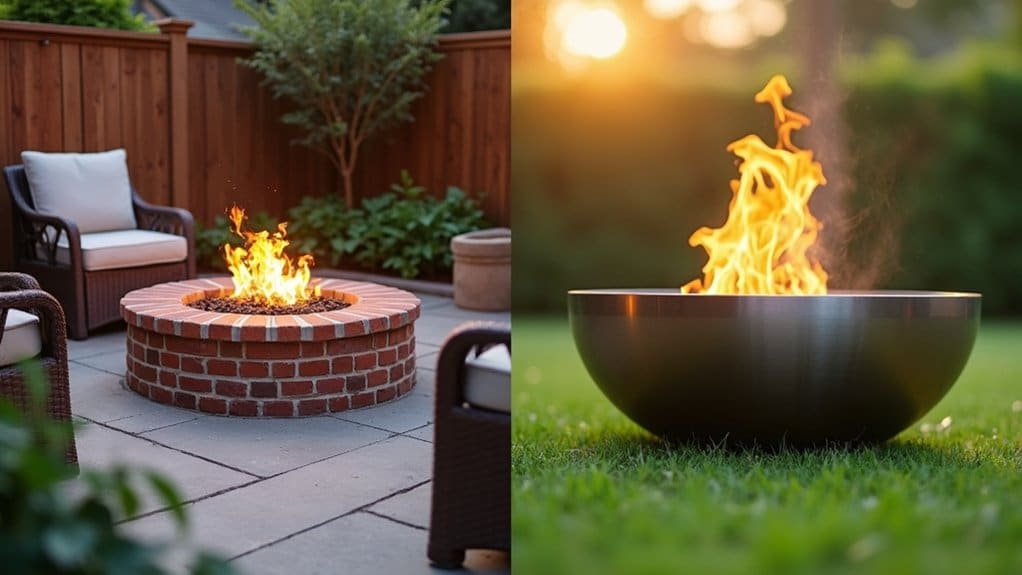
How well a fire pit fits a small backyard depends less on style and more on footprint and flexibility. Portable fire pits work best in a compact backyard because they don’t lock you into one layout. You can reposition them for different gatherings or store them when you need the space back.
In a small backyard, the best fire pit is the one you can move or put away.
Built-in fire pits only make sense if your yard supports a dedicated gathering zone with proper clearance. One popular option for outdoor heating and ambiance is woodburning fire pits in Florida. These fire pits can create a cozy atmosphere for gatherings, especially during cooler evenings.
For small footprints, prioritize:
- Round portable designs that suit intimate seating arrangements
- Tabletop or minimalist metal formats that minimize ground coverage
- Propane fuel for clean operation without wood storage demands
- Lightweight construction so you can shift placement seasonally
Match the fire pit to your square footage, not the other way around.
Why Permanence Should Shape Your Choice
Whether you’re committing to a permanent landscape feature or keeping your options open with a moveable unit, permanence is the factor that should guide your decision. A built-in fire pit locks into your patio layout and becomes part of your property’s design, while a portable model lets you adjust placement as your backyard evolves. Understanding that tradeoff between long-term integration and flexible use helps you choose the option that actually fits how you’ll use your outdoor space.
Long-Term Commitment Matters
Consider these factors before deciding:
- A $6,000 custom fire pit may add roughly $4,000 to your home’s value.
- Well-built inserts help permanent fire pits last indefinitely.
- Portable units often need earlier replacement due to weather and heat damage.
- Permanent features read as landscape amenities to buyers, not removable accessories.
Match your commitment level to your long-term backyard plans.
Flexibility Versus Fixed Design
Because portable fire pits weigh less than 75 pounds in many cases, you can reposition them across your yard as furniture layouts shift or seasonal needs change. This makes a portable fire pit practical for multi-use patios where a single fixed feature would limit how you arrange seating or circulation.
Permanent installations anchor your layout around the fire feature itself. Whether you’re working with a masonry surround or a prefab fire pit insert, the surrounding hardscape and seating need to be planned in relation to that fixed point. That commitment works when your backyard design is settled and you want a consistent gathering zone.
If future renovations or patio expansions are likely, a portable option reduces restriction. Match the level of permanence to how much change you expect.
When a Portable Fire Pit Makes More Sense
For homeowners who aren’t ready to commit to a permanent hardscape feature, a portable fire pit often makes more practical sense. Unlike a built-in paver fire pit or concrete fire pit, a portable unit like the Solo Stove Bonfire lets you reposition your setup as your yard evolves.
Portable fire pits work best when:
- You’re renting, moving soon, or testing whether you’ll use a fire feature regularly
- Your budget sits closer to $500, $1,000 rather than the $3,000, $5,000 range for built-in installations
- You want to skip permits, gas line work, and contractor scheduling
- Your space is too small for a permanent structure or you’re still planning a larger redesign
They’re a low-risk entry point that doesn’t lock your backyard into one fixed layout.
When a Built-In Fire Pit Is Worth the Investment
A built-in fire pit makes sense when you’re ready to commit to a permanent backyard feature that adds lasting landscape value. It becomes a natural entertainment centerpiece that anchors your outdoor space around a fixed gathering point. When built with materials that match your patio, seating walls, or surrounding hardscape, it delivers the kind of polished architectural integration a portable unit can’t replicate.
Long-Term Landscape Value
When you’re weighing the upfront cost of a built-in fire pit against a portable alternative, long-term return matters more than sticker price. A $6,000 custom fire pit can add roughly $4,000 to your home’s value, reflecting the 67% ROI reported by the National Association of Realtors.
Built-in fire pits also outlast portable units by a wide margin:
- Stone materials last 30, 50+ years
- Brick materials last 20, 30 years
- In-ground fire pits average 20, 30+ years of service
- Portable units typically last just 3, 10 years
If you’re staying in your home for five or more years, a built-in pit integrates directly into your hardscape and becomes a permanent fixture, not a replaceable appliance. That durability compounds your return over time.
Permanent Entertainment Centerpiece
Beyond ROI and material lifespan, a built-in fire pit earns its cost when it functions as your yard’s primary entertainment centerpiece, a fixed gathering point that anchors how you use your outdoor space.
If you’re hosting regularly, a permanent installation supports conversation zones, seating arrangements, and dining setups that a portable unit can’t sustain. Stone, brick, or paver surrounds define the area like an outdoor room, giving the fire pit structural context within your hardscape.
A plumbed natural gas connection reinforces that permanence, no tank swaps, no repositioning. You’re building a dedicated social zone rather than placing a movable accessory.
The investment makes sense when your backyard layout already supports a fixed gathering area and you’ll use it consistently. That’s when a built-in fire pit stops being an upgrade and becomes the space’s defining feature.
Polished Architectural Integration
Built-in fire pits deliver their strongest return not as standalone heat sources but as elements within a coordinated landscape composition, where the fire feature’s form, materials, and placement reinforce the architecture already shaping your yard. Modern fire walls for outdoor spaces add an additional layer of warmth and ambiance to an outdoor gathering. They create a visual focal point that complements the landscaping while providing a safe barrier from flames.
When you’re matching stone, concrete, or block across patios, walls, and seating, the fire pit reads as part of the space rather than an addition to it. Clean coping, concealed gas lines, and consistent edge detailing strengthen that effect.
A built-in fire pit integrates best when your design includes:
- Matching material palette across hardscape, seating walls, and the fire feature itself
- Geometric alignment with your home’s architectural lines, rectangular, linear, or circular
- Integrated seat walls that frame the fire pit and define circulation
- Embedded placement within existing paver or stone patios
Cost vs. Permanence: How to Make Your Final Call
Everything comes down to two variables: how much you’re willing to spend upfront and how long you plan to keep the feature in place. A portable unit at $300, $700 makes sense if you’re renting, testing layouts, or using fire seasonally. A built-in at $1,500, $5,000+ justifies itself when you’re committing to a 5, 10 year design and entertaining regularly.
Check local permit requirements before choosing a permanent gas-line installation, regulations and HOA rules can eliminate built-in options entirely. If your backyard serves multiple functions, a portable pit you can store keeps the space adaptable. If you’ve already invested in a cohesive patio or hardscape, a built-in anchors the design permanently. Match the feature’s lifespan to your own timeline, and the budget question answers itself.
Call Today and Build a Custom Fire Feature
From custom fire pits to modern fire walls and bowls, the right fire feature adds warmth, value, and unforgettable curb appeal. At Innovative Outdoor Living, our skilled team provides trusted Backyard Makeovers built around your style, space, and outdoor lifestyle. Call +1 (561) 594-1495 today and bring your backyard vision to life.
Frequently Asked Questions
Do Built-In Fire Pits Increase Home Resale Value?
Built-in fire pits can increase your home’s resale appeal, though you won’t recoup every dollar. A natural stone gas fire pit may return around 67% of your investment, and listings mentioning a fire pit tend to sell about 2.8% higher and nearly four days faster. You’ll see the strongest impact when you integrate quality materials into a cohesive outdoor living space rather than adding a standalone feature.
How Long Do Portable Fire Pits Typically Last?
Portable fire pits typically last many years, but your material choice drives the real number. A well-built corten steel pit at 2mm, 3mm thickness can last 25+ years, while stainless steel and cast iron models also deliver strong longevity. Lighter, compact designs won’t hold up as long. You’ll extend any portable pit’s life by prioritizing weather-resistant construction, maintaining gas components, and storing it properly between seasons.
Can a Portable Fire Pit Damage a Wooden Deck?
Yes, a portable fire pit can damage a wooden deck. Heat radiating downward can reach 200 to 400°F, which is enough to scorch, blacken, or weaken wood over time. Composite decking can soften at just 176°F. You’ll want a non-combustible base like pavers or a fire pit mat extending at least 24 inches on all sides. Gas or propane models are safer choices since they don’t produce sparks or embers.
Do Fire Pits Require Homeowners Insurance Policy Updates?
Permanent fire pits may require a policy update since they can change how your insurer classifies outdoor structures. You’ll want to notify your carrier before or after installation to confirm your coverage limits still apply. Portable units are usually simpler, they’re typically covered as personal property. Either way, you should review your liability limits and consider whether an umbrella policy makes sense given the added exposure a fire feature creates.
Are Fire Pits Legal in All Residential Neighborhoods?
No, fire pits aren’t legal in every residential neighborhood. Your local county, city, and zoning codes determine what’s allowed, and HOA rules can add further restrictions. Most areas require setbacks of 10, 25 feet from structures, fences, and property lines. You’ll also need to follow fuel, fire-size, and supervision rules. Before you design a built-in or choose a portable unit, check your local fire codes and permit requirements first.