
When designing your Florida backyard fire pit, you’ll want to match your fuel type, materials, and layout to your space and local codes. Propane offers portability, while natural gas keeps long-term costs low. Corrosion-resistant materials like stainless steel and aluminum handle humidity best. Costs range from $300 for a DIY build to $30,000+ for custom installations. Below, you’ll find everything you need to choose the perfect fire feature for your outdoor space.
Which Fire Pit Type Works Best in Florida?
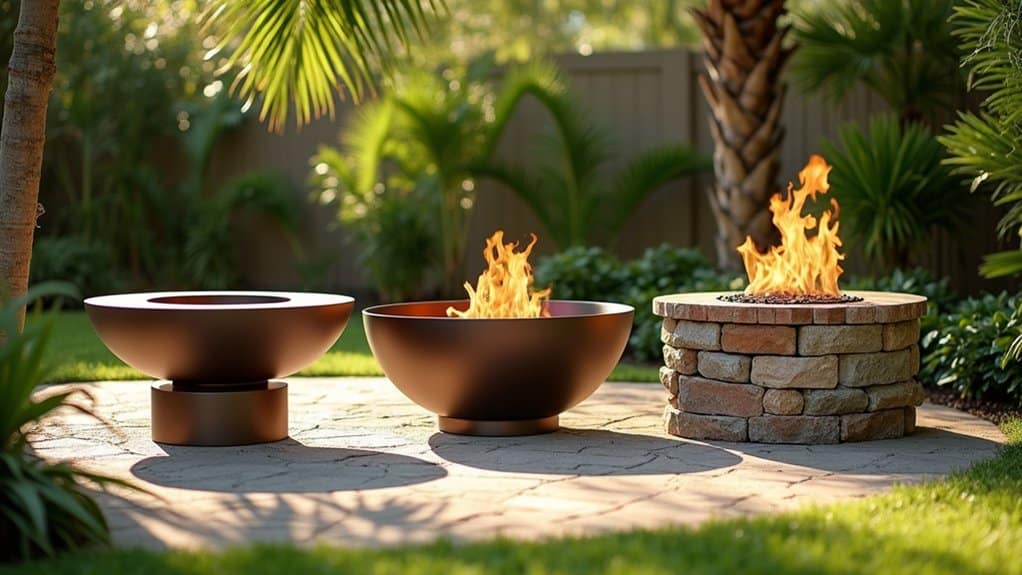
Propane models give you portability and flexible placement across patios or decks. Natural gas units, once installed, deliver the lowest long-term fuel costs and a permanent design anchor.
For smaller spaces, fire bowls and fire tables pull double duty, combining flame with functional surface area. Built-in designs using stone, brick, or pavers create a lasting focal point that handles moisture and heat exposure. Whatever you choose, prioritize weather-rated materials and non-combustible foundations for safety and longevity. Gas fire pits in particular are clean-burning and easy to control, making them a popular choice for Florida homeowners pairing fire features with deck installations.
Wood, Propane, or Gas: How to Pick Your Fuel
Once you’ve narrowed down the right fire pit style for your space, your fuel choice shapes everything from the look and feel of the flame to how the feature fits your backyard’s long-term design. When deciding between wood, propane, or gas: how to pick your fuel comes down to balancing aesthetics, flexibility, and infrastructure.
| Feature | Wood vs. Gas |
|---|---|
| Ambiance | Wood delivers crackle and smoke; gas offers clean, controlled flames |
| Portability | Propane is most flexible; natural gas is fixed |
| Starting Cost | Wood from a few hundred; natural gas from $2,000+ |
| Maintenance | Gas requires minimal cleanup; wood demands regular tending |
Propane suits rearranged layouts, while natural gas anchors permanent designs beautifully. Keep in mind that wood fire pits are considered the most dangerous option due to heat and embers, so local regulations and safety guidelines should always factor into your decision.
What Size Fire Pit Fits Your Patio?
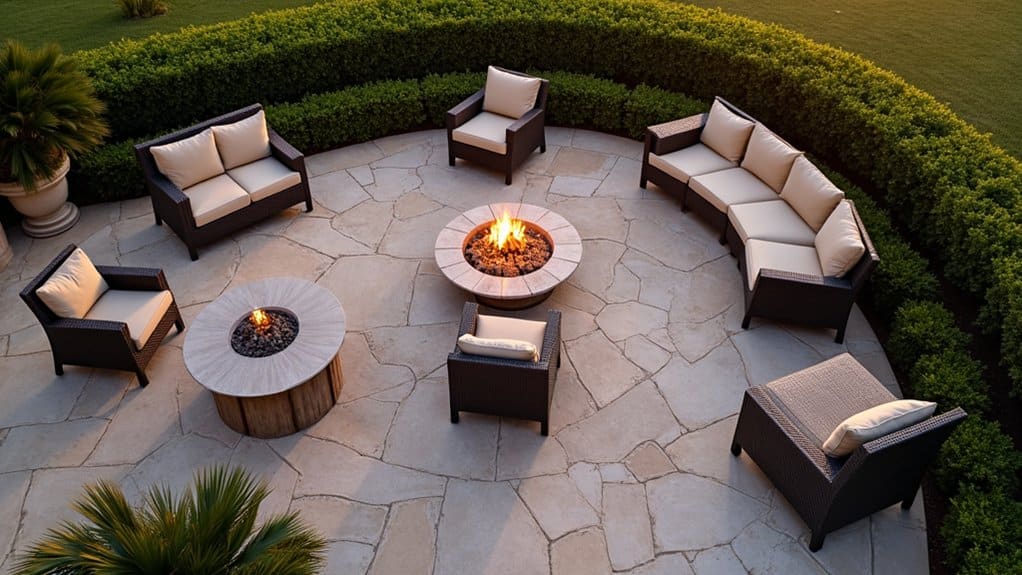
How well your fire pit fits your patio comes down to proportion, not just preference. Your fire pit and its safe zone should occupy no more than one-third of your total patio area. On an 8×8-foot patio, a 30-inch portable unit works. A 12×12-foot space pairs well with a 36, 44-inch fire pit, while a 16×16-foot patio can handle a 44, 60-inch feature with room for seating.
Plan for at least six feet of clearance on all sides between the fire pit and patio edge. A 36, 44-inch pit supports four to six chairs comfortably. Wood-burning pits need greater clearance than gas or portable options due to the risk of sparks. Getting proportions right from the start keeps your fire pit installation cost efficient, you won’t waste materials on a patio that’s oversized or crowd a space that’s undersized.
Fire Pit Spacing and Setback Rules to Follow
Before you finalize your fire pit’s placement, you’ll need to account for both the clearance around your seating area and the required setback distances from structures, fences, and property lines. Most Florida counties require wood-burning pits to sit 25 feet from any structure, while gas fire pits may be permitted as close as 5, 10 feet depending on local code. Plan for at least 6, 7 feet of open space around the pit itself so your layout feels spacious and keeps guests comfortably outside the heat zone.
Safe Clearance Around Pits
Because fire pits generate intense radiant heat and airborne sparks, every inch of clearance around them matters for safety and smart space planning. You’ll want at least 10 feet of horizontal distance from your home, deck, fence, and any combustible materials. For vertical safe clearance around pits, maintain a minimum of 7 feet between the flame and any overhead structure like a pergola or patio cover.
Position seating about 3 feet back from the pit’s outer edge to balance warmth with comfort. Place your fire feature on a non-combustible surface, concrete, pavers, or compacted gravel, and keep firewood storage at least 30 feet away. Clear dry leaves, loose debris, and clutter from the entire fire zone before lighting up.
Required Building Setback Distances
Local ordinances vary, so verify your county’s specific rules before committing to a layout. Wind direction, vertical clearance beneath pergolas, and property-line proximity all factor into compliant, visually balanced placement.
Best Fire Pit Materials for Florida Weather
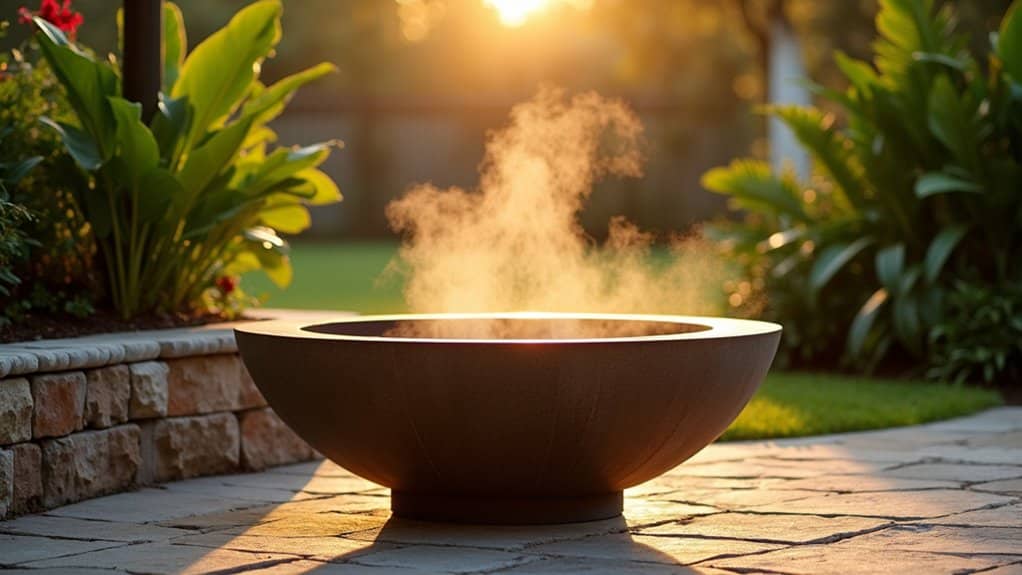
Florida’s heat, humidity, and coastal salt air demand materials that won’t corrode, crack, or deteriorate after a few seasons. You’ll want to weigh stainless steel against aluminum for sleek, modern designs, consider natural stone for built-in features that anchor your layout, and prioritize humidity-resistant picks that hold up without constant maintenance. The right material choice shapes both the look and longevity of your fire pit, so it’s worth matching each option to your backyard’s style and exposure.
Steel Versus Aluminum
Material choice shapes how well your fire pit holds up against Florida’s humidity, rain, and salt air. When comparing steel versus aluminum, each material brings distinct advantages depending on your backyard’s design direction and location.
Aluminum naturally resists rust by forming a protective oxide layer, making it ideal for coastal settings where salt air accelerates corrosion. It’s lightweight, low-maintenance, and pairs well with modern fire tables and sleek patio layouts. A simple wipe-down with mild soap keeps it looking sharp.
Steel delivers a heavier, more traditional presence that suits rugged or classic designs. However, it demands consistent upkeep, protective coatings, covers, and rust inspections, especially in Florida’s wet climate. For inland backyards where you’ll commit to regular maintenance, steel remains a solid performer.
Natural Stone Durability
Natural stone brings a raw, textured aesthetic to fire pit designs that manufactured materials can’t replicate, but not every stone performs equally under Florida’s heat, humidity, and coastal exposure.
When evaluating natural stone durability, quartzite ranks highest, it’s harder than granite and highly resistant to heat, water, and abrasion. Granite follows closely, offering excellent storm resistance, low porosity, and minimal UV fading. Both perform well in coastal settings with proper sealing.
Slate works but demands more maintenance in Florida’s moisture-heavy climate. Travertine stays cool underfoot, making it appealing around sun-exposed seating areas, though it’s porous and requires consistent sealing to prevent deterioration.
For fire pit surrounds and caps, you’ll get the strongest long-term performance from dense, low-porosity stones that tolerate temperature swings without cracking.
Humidity-Resistant Material Picks
Even the most striking natural stone surround won’t hold up if the metals, masonry, and interior materials around it can’t handle Florida’s relentless moisture. Your humidity-resistant material picks should pair corrosion-proof metals with fire-rated interiors that drain well and resist heat cycling.
| Material | Best Use | Florida Performance |
|---|---|---|
| Stainless steel | Portable or modern builds | Resists rust in coastal humidity |
| Aluminum | Lightweight fire tables | Won’t corrode like untreated steel |
| Fire brick | Interior lining | Handles direct flame and moisture |
| Heat-treated concrete | Custom structures | Flexible styling, fire-resistant |
| Lava rock | Pit base layer | Supports heat management and drainage |
Line your interior with fire brick, avoid pea gravel, and coat exposed metals with heat-resistant finishes to protect your investment.
Florida Fire Codes You Need to Check First
Before you choose a fire pit style or material, you’ll need to check your local fire codes, because in Florida, city and county regulations control what you can install, where you can place it, and which fuel types are permitted. Your city’s fire department and building department are the first stops for clearance rules and permit requirements.
Among the Florida fire codes you need to check first: minimum setback distances (commonly 10, 25 feet from structures), size limits on self-constructed pits (some municipalities cap diameter at 8 feet), and restrictions on open burning within city limits. HOA covenants can impose additional limits on visible flames or fuel types. Document everything, ordinance numbers and permit conditions protect you during inspections or neighbor disputes and keep your design compliant from the start.
How Much Does a Fire Pit Really Cost?
Your fire pit budget can range from under $300 for a simple portable unit to $5,000+ for a custom stone or gas-powered installation, so understanding where your money goes shapes every design decision you’ll make. Beyond the sticker price, you’ll need to account for gas line work, site prep, drainage, and annual maintenance that can quietly add $500, $2,500 to your total investment. The right fire feature isn’t just about cost, it’s about choosing a design that anchors your outdoor space and earns its place in your backyard layout for years.
Budget Tiers Explained
Fire pit costs split into four main tiers, and knowing where each one lands helps you design around a realistic number instead of guessing.
Entry-level DIY builds run $300 to $1,500 using stone rings or prefabricated inserts. Lower-mid professionally installed features fall between $3,000 and $8,000 with cleaner finishes and proper site prep. Midrange custom builds with integrated seating reach $5,000 to $12,000. High-end fire features, linear walls, large gas tables, full outdoor living anchors, start around $12,000 and stretch past $30,000.
Several budget tier factors shape where you’ll land: fuel source, material selection, surrounding hardscape scope, and DIY versus professional installation. Wood-burning stays cheaper upfront while gas adds cost for cleaner operation. Keeping your fire bowl between 36 and 48 inches controls material spend without sacrificing gathering space.
Hidden Cost Factors
Most homeowners focus on the fire pit itself, but the real budget lives in what surrounds it, material upgrades, fuel infrastructure, site prep, and code compliance can quietly double your project cost. Understanding these hidden cost factors is essential to any outdoor fire pit guide.
| Cost Category | Typical Impact |
|---|---|
| Gas line work + permits | $250, $4,000+ added to installation |
| Natural stone veneer vs. block | $15, $30/sq ft vs. basic concrete pricing |
| Accessories + maintenance | $100, $500+ for covers, screens, grates |
Site grading, drainage correction, and soil stabilization add labor you won’t see in a product listing. Gas systems eliminate ash cleanup but require inspections. Wood-burning setups look cheaper upfront, yet firewood storage in Florida’s humidity creates recurring expense. Budget for the full picture.
Value Beyond Price
The real value isn’t the burner, it’s the space the fire feature activates. A well-placed fire bowl draws guests outward, extends evening usability, and gives your patio architectural weight. Premium builds reaching $20,000+ work because they treat the fire element as one layer within a larger composition: kitchen, pergola, lounge, landscape.
You’re not buying a fire pit. You’re designing a destination. Measure cost against how much livable space the investment actually creates.
Fire Pit Features Worth Paying More For
When you’re choosing a fire pit, certain upgrades pay for themselves in comfort, durability, and visual impact. Powder-coated aluminum frames handle Southwest Florida’s humidity and salt air better than most alternatives. Fire glass elevates your fire feature outdoor living aesthetic while improving heat distribution across the seating area.
Wind guards stabilize flames in exposed settings, keeping the visual effect consistent even on breezy evenings. Swivel seating creates a more social, flexible layout around your fire pit without locking guests into fixed positions.
Protective covers might seem minor, but they shield your investment from moisture, debris, and UV damage year-round. Each of these additions strengthens how your fire pit looks, performs, and lasts, making them worth prioritizing over cheaper alternatives that’ll need replacing sooner.
Common Fire Pit Mistakes Florida Buyers Make
Even a well-designed fire pit can become a liability if you overlook Florida’s permit requirements, placement rules, or fuel system specs. Skipping AHJ review, ignoring setbacks, or assuming your project is permit-exempt creates compliance risk that’s costly to correct after construction.
Placement matters just as much as design. Positioning too close to structures, fences, or overhanging branches compromises safety, and undermines the aesthetic you’re trying to create. When exploring backyard fire pit ideas, factor in prevailing wind patterns, property-line distances, and non-combustible surface requirements beneath and around the feature.
Gas system mistakes are equally common. Undersized lines reduce flame quality, while wrong regulators or skipped pressure testing introduce real hazards. Don’t overlook drainage planning either, Florida’s storms erode weak foundations fast, shortening your fire pit’s lifespan considerably.
How to Pick the Right Fire Pit for Your Space
How well a fire pit fits your space depends less on the feature itself and more on the layout surrounding it. Measure your usable footprint first, then map seating, circulation paths, and clearance zones before selecting a style. A compact yard benefits from a portable or low-profile design, while larger spaces can support a destination layout with an in-ground fire pit as the central focal point.
Match proportions carefully. An oversized feature crowds a small patio; an undersized one disappears in an open yard. Choose fuel type based on how you’ll actually use the space, gas for clean, frequent entertaining or wood-burning for a traditional gathering feel. Factor in your material choices, local setback requirements, and whether the design connects visually to your existing hardscape and landscaping.
Call Today and Build a Custom Fire Feature
From custom fire pits to modern fire walls and bowls, the right fire feature adds warmth, value, and unforgettable curb appeal. At Innovative Outdoor Living, our skilled team provides trusted Backyard Makeovers built around your style, space, and outdoor lifestyle. Call +1 (561) 594-1495 today and bring your backyard vision to life.
Frequently Asked Questions
Can I Use a Fire Pit Year-Round in Florida?
Yes, you can use a fire pit year-round in Florida. The mild winters make your fire pit more of an ambiance feature than a heat source, which opens up sleek design options like gas fire tables and linear burners. You’ll want to keep the fire attended at all times and follow local setback and HOA rules. A well-placed, contained fire feature becomes a stunning focal point across every season.
Do I Need a Permit to Install a Backyard Fire Pit?
You usually don’t need a permit for a small, portable recreational fire pit in Florida. However, built-in masonry fire features, gas line connections, or larger permanent installations often require building permits and inspections. Setback rules, fuel restrictions, and size limits vary by city and county, so you’ll want to check your local codes and HOA guidelines before finalizing your design to guarantee your fire feature meets all requirements.
How Do I Protect My Fire Pit During Hurricane Season?
You’ll want to secure or relocate portable fire pits and propane tanks before storms hit. Cover permanent features with heavy-duty, fitted covers and use ratchet straps to stabilize surrounding furniture. Turn off gas lines, disconnect propane, and remove loose décor that could become projectiles. After the storm, inspect for cracked burners, warped metal, and water damage before relighting. Photograph everything before and after to support any insurance claims.
Can a Fire Pit Increase My Home’s Resale Value?
Yes, a fire pit can boost your home’s resale appeal. A natural stone gas fire pit typically delivers around 67% ROI, so a $6,000 project returns about $4,000 in added value. You’ll see the strongest impact when your fire pit complements a cohesive outdoor design with coordinated seating, materials, and landscaping. Built-in, professionally designed features read as permanent and intentional, making your backyard feel like a curated living space buyers can’t resist.
Are Fire Pits Safe to Use Near a Screened-In Lanai?
Gas fire pits can work safely near a screened-in lanai when you meet clearance and ventilation requirements. You’ll want at least 36 inches of side clearance and 80 inches of overhead clearance, with permanently open screened walls allowing strong airflow. Avoid wood-burning units near your lanai since smoke, sparks, and embers create serious risks in enclosed spaces. Always check local codes and manufacturer guidelines before designing your setup.