For commercial outdoor audio in 2025, you’ll want to focus on weather-resistant speakers like the Bose FreeSpace 51 or JBL Control 23-1, which offer IP55-rated protection and flexible mounting options. Install these units 15-20 feet apart at 6-8 feet height, angled downward for ideal coverage. You’ll need 70V/100V amplification systems for efficient power distribution across large spaces. The right combination of placement, power, and protection will transform your outdoor audio experience.
Understanding Commercial-Grade Outdoor Audio Systems
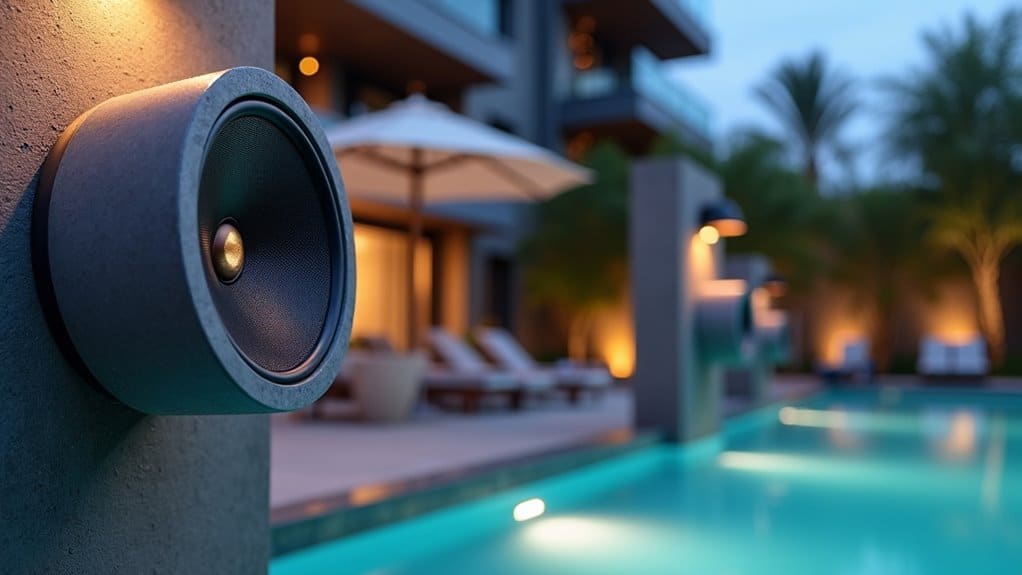
Commercial-grade outdoor audio systems stand apart from residential solutions, delivering sturdy performance and reliability that businesses can count on. You’ll find these systems are engineered with weather-proof enclosures that protect crucial components from rain, dust, and temperature extremes, guaranteeing consistent sound quality year-round.
The system’s 70-volt configuration makes it easy to scale your outdoor sound coverage, whether you’re outfitting a small patio or an expansive commercial venue. You can choose from diverse speaker styles – surface-mount, in-ground, or pendant designs – to match your space’s architecture while maintaining professional aesthetics.
Modern commercial systems offer unprecedented flexibility in audio management, letting you integrate streaming services, paging systems, and background music. This versatility confirms your outdoor sound system adapts to your business’s evolving audio needs.
Top Weather-Resistant Speaker Models for Business Environments
Selecting the right weather-resistant speakers can make or break your outdoor commercial audio system’s performance. You’ll find extensive sound solutions in models like the Bose FreeSpace 51, designed specifically for permanent outdoor installations with its weatherproof construction.
For all-encompassing coverage, consider the JBL Control 23-1’s 110-degree dispersion and UV-resistant enclosure, or the Yamaha VXS8’s IP55 weather-resistant rating with flexible impedance options. The Polk Audio Atrium 4 delivers reliable 100-watt power handling in a sealed enclosure, perfect for consistent outdoor performance.
When you need to blend aesthetics with functionality, Klipsch AW-650 terrain speakers offer camouflaged housing and dual driver configuration. Each model provides specific advantages for your commercial space, from waterproof Bluetooth capabilities to advanced weather protection, ensuring year-round speaker system reliability.
Essential Features for Professional Outdoor Sound
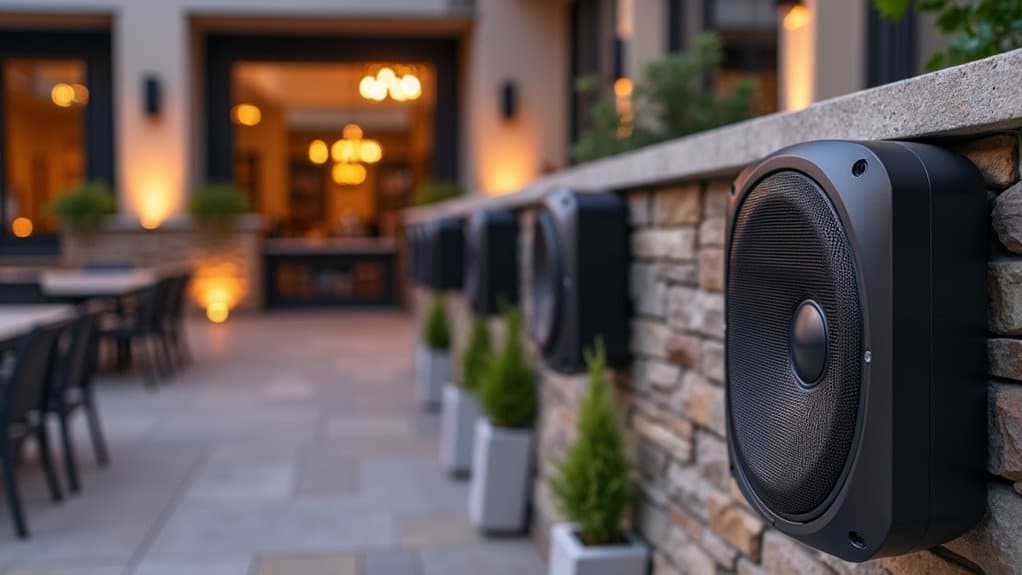
While residential audio systems may suffice for small patios, professional outdoor sound installations demand specific features to deliver reliable performance in commercial environments. You’ll need speakers that are both waterproof and dust-proof to withstand the elements year-round, guaranteeing consistent operation in rain, snow, or intense sun exposure.
To fill large spaces effectively, look for units with high-quality sound characteristics, including broad frequency response and low distortion. These features guarantee clear music and speech reproduction across expansive outdoor areas. Your installation options should be versatile, with flexible mounting options accommodating surface, in-ground, or pendant configurations. For scalable commercial systems, compatibility with 70V/100V distributed audio systems is vital, allowing you to expand your setup while maintaining consistent sound quality throughout the venue.
Strategic Speaker Placement for Maximum Coverage
When planning your commercial outdoor audio setup, you’ll need to position speakers approximately 15-20 feet apart to create effective sound overlap zones while maintaining clarity. You should mount your speakers at 6-8 feet high and angle them 10-15 degrees downward and inward in the direction of the primary listening area to achieve suitable coverage and minimize sound reflections. Your perimeter-based installation strategy needs to account for both direct-radiating and wide-dispersion speakers to guarantee uniform sound distribution across high-traffic zones.
Distance Between Speaker Units
To achieve ideal sound coverage in commercial outdoor spaces, proper speaker spacing plays a pivotal role in delivering consistent audio quality throughout the listening area. In smaller outdoor spaces, position your speaker system units 20-30 feet apart, while larger commercial venues require 30-50 feet spacing for optimal stereo sound distribution.
When planning your speaker placement, measure your outdoor space dimensions and implement the one-third rule: position listeners at a distance that’s one-third of the gap between speakers. You’ll need to account for physical obstacles like trees, buildings, and furniture that could impact uniform audio distribution. Angle your speakers strategically to eliminate dead spots and guarantee even coverage across the entire listening area. This calculated approach certifies that your commercial space delivers professional-grade sound performance.
Height and Angle Positioning
Since crucial sound projection depends heavily on vertical positioning, mounting your outdoor speakers at the right height and angle becomes indispensable for commercial spaces. You’ll want to mount outdoor speakers above ear level, angling them downward at 30-45 degrees to direct sound toward your outdoor area.
For a optimal listening experience, stagger your speaker wire installations at varying heights throughout the sound system. This multi-level approach creates depth in your outdoor listening environment, regardless of the space’s shapes and sizes. Position units 30-50 feet apart to establish seamless coverage, and fine-tune each speaker’s tilt to address specific layout challenges. Remember, proper height positioning combined with strategic angles guarantees your commercial sound reaches every corner effectively, delivering professional-grade audio performance across the entire venue.
Sound Overlap Zones
Building on proper height positioning, strategic sound overlap zones form the backbone of exhaustive audio coverage in commercial outdoor spaces. The right speakers and overlap calculations guarantee your outdoor system delivers consistent sound to every corner of your venue.
- Plan for 15-20% sound overlap between adjacent speakers to eliminate dead zones and maintain uniform volume
- Map your space’s high-traffic areas initially, then work outward to determine ideal speaker placement
- Use a decibel meter to measure and adjust overlap zones during system setup
- Consider seasonal changes in foliage and temporary structures that might affect sound distribution
- Test your system makes consistent coverage during peak business hours when ambient noise is highest
When properly configured, sound overlap zones create a seamless audio experience that’ll keep your customers comfortable whether they’re near or far from individual speakers.
Power Requirements and System Integration
When planning a commercial outdoor audio system, proper power requirements and system integration serve as the foundation for reliable performance. You’ll want to focus on 70V or 100V amplifiers, which excel at distributing audio across extensive spaces while maintaining signal quality. For demanding environments, select speakers rated at 100W or higher to guarantee adequate coverage and headroom.
To maximize system flexibility, integrate wireless streaming capabilities that let you connect modern audio sources seamlessly. However, don’t overlook compatibility between components your amplifiers, speakers, and wireless interfaces must work together harmoniously. It’s worth consulting professional audio designers who can assess your specific needs and recommend the right combination of equipment. They’ll help you optimize power distribution, speaker placement, and system integration for your commercial space’s unique requirements.
Maintenance and Long-Term Performance Optimization
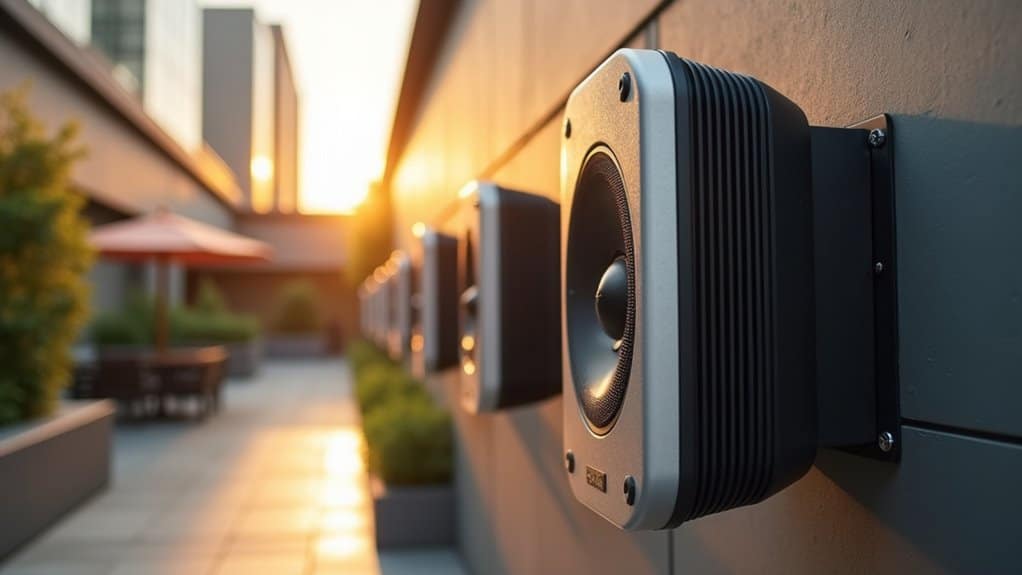
To optimize the lifespan and performance of commercial outdoor speakers, implementing a thorough maintenance strategy is crucial. You’ll need to focus on regular inspections and proactive care to safeguard your system’s durability in challenging environments.
- Check weatherproofing seals monthly and replace deteriorated components to prevent moisture damage
- Implement proper cable management by securing loose wires and protecting connections from UV exposure
- Perform quarterly volume adjustments and EQ calibration to maintain ideal sound quality across varying conditions
- Inspect and tighten all hardware connections every three months to prevent vibration-related issues
- Document any physical damage during routine checks and address repairs immediately to prevent system failure
Regular maintenance isn’t just about preventing problems it’s about maximizing your investment’s performance and extending its useful life through systematic care and attention to detail.
Frequently Asked Questions
What Is the Best Speaker for Outdoors?
For ideal outdoor sound, you’ll want to evaluate the Bowers & Wilkins AM-1. It offers superior sound quality with its 2-way design and aluminum-dome tweeter, while providing exceptional durability through its weatherproof housing. You’ll get powerful output and precise audio reproduction that’ll withstand the elements. The installation’s straightforward, maintenance is minimal, and its versatile mounting options make it perfect for any outdoor space. It’s the perfect balance of performance and weather resistance.
Which Is the No. 1 Speaker Brand?
You’ll find that Bose consistently ranks as the #1 speaker brand globally, setting industry standards for speaker quality and sound distribution. They’ve earned this position through superior engineering, delivering unmatched audio clarity across their product range. You’re getting exceptional durability and weather resistance, plus versatile installation options and smart features in their offerings. When you’re considering power requirements and connectivity, Bose’s pioneering solutions demonstrate why they’re the industry leader.
What Is the Lifespan of Outdoor Speakers?
You’ll find that outdoor speakers typically last 10-15 years with proper care, though your speaker durability largely depends on weather resistance performance and installation requirements. For ideal lifespan, you’ll need to assess proper speaker placement, regular maintenance needs, and balanced power consumption. Commercial-grade outdoor acoustics systems can even extend beyond 20 years when you maintain them properly with periodic inspections, protective coatings, and professional servicing.
Who Makes World’s Best Speakers?
You’ll find that Bowers & Wilkins consistently ranks as the world’s leading speaker manufacturer, known for exceptional speaker quality and refined aesthetics. However, brands like Focal and Klipsch also deliver outstanding speaker power output and durability. When you’re evaluating the “best,” consider that each brand excels in different areas – Focal leads in sound accuracy, Sonos dominates speaker connectivity, and Yamaha masters weather resistance and installation versatility.