A backyard fire pit costs between $200 and $8,000+, depending on size, material, fuel type, and installation method. You’ll pay $200, $900 for a 36-inch pit, while 60-inch custom designs run $1,200, $1,800. Concrete’s your most affordable material at $150, $1,000, and natural stone tops $4,000+. DIY kits start at $100, but professional gas installations exceed $8,000. Operating costs range from $0.39/hour for electric to $1.32/hour for propane. Below, you’ll find the full cost breakdown for every budget level.
What Does a Backyard Fire Pit Actually Cost?
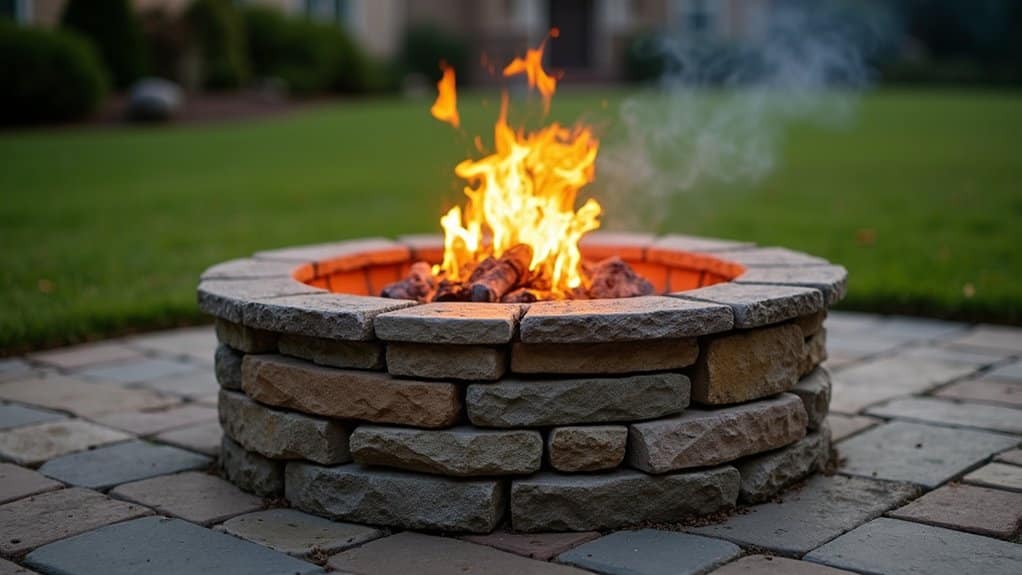
Whether you’re envisioning a simple portable setup or a fully custom stone surround, a backyard fire pit typically costs between $250 and $2,200 for materials and labor combined. The national average lands around $830 to $850, with low-end portable units starting at $200 and high-end custom builds reaching $5,000.
Your final price depends on several factors. Choosing right fire pit material impacts your budget considerably, concrete runs $150 to $1,000, while natural stone climbs to $3,000. Fuel type, installation complexity, and understanding fire pit regulations in your area also affect total costs. Professional installation adds $480 to $1,000, with labor rates between $60 and $125 per hour. Plan for $100 to $300 annually in ongoing maintenance expenses. Gas line installations alone can add $300 to $500, and permits may tack on an additional $50 to $500 depending on your municipality.
Fire Pit Costs by Size: 36-Inch to 60-Inch
Everyone shopping for a backyard fire pit should understand that size drives cost more than almost any other factor. A 36-inch pit runs $200 to $900 installed, while a 48-inch unit hits $1,120 on average. At 60 inches, you’re looking at $1,200 to $1,800 for custom designs.
Your backyard fire pit design elements directly impact pricing at every diameter. A 40-inch model averages $730 installed, and a 44-inch build reaches $900. Each size increase demands more bricks, stone, and labor hours. Larger fire pits cost more because increased materials and labor are needed to accommodate the expanded footprint.
Don’t overlook fire pit safety considerations when scaling up. Larger pits require proper clearances, more fire bricks, 80 to 90 for a 36-inch build alone, and sturdier surrounds. Budget accordingly: jumping from 36 to 60 inches can triple your total project cost.
Portable vs. In-Ground Fire Pit Costs Compared
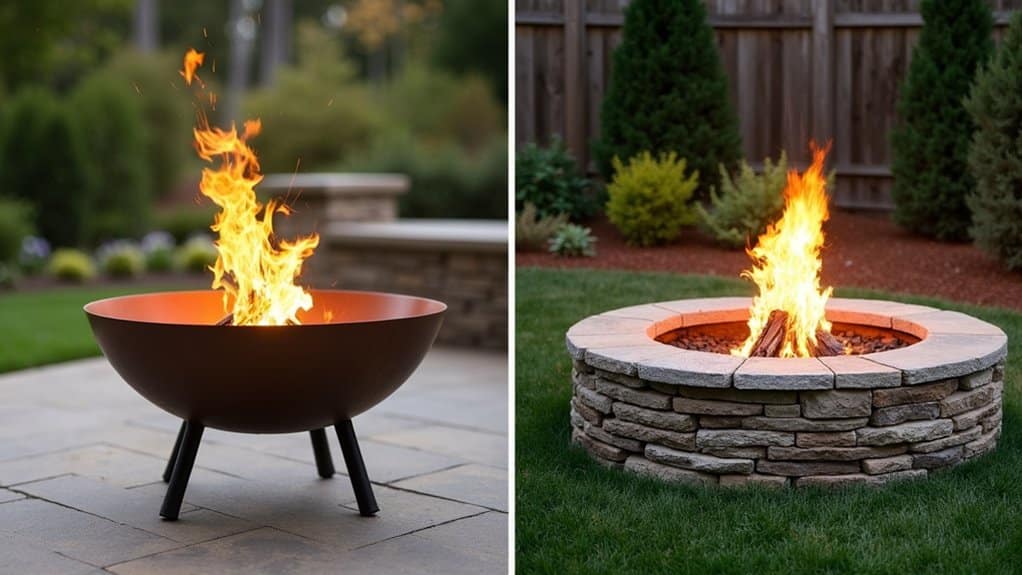
Because portable and in-ground fire pits serve the same function, many homeowners assume they carry similar price tags, but first-year costs tell a different story. Portable units run $199, $699 with zero labor, while in-ground builds range $850, $3,400 including excavation and materials.
The gap narrows over five years. Portable fuel costs plus $120 annual maintenance for covers and rust treatment push the total to $759. In-ground pits reach $1,075 at just $45 yearly upkeep, and last decades without replacement. Portable steel bases corrode 0.8mm within six months, compromising structural integrity. In-ground pits also require 23% less wood to maintain comfortable seating-zone temperatures, further reducing ongoing fuel expenses.
Beyond dollars, in ground aesthetics add lasting property value. You’ll also gain 95% ember containment, lower surface temperatures, and fewer HOA conflicts, advantages portable options can’t match at any price point.
Fire Pit Costs by Material: Concrete, Steel, Brick, and Stone
Each material you choose for a fire pit directly shapes both your upfront costs and long-term maintenance budget. Concrete runs $150, $1,000 installed, making it the most affordable option. You can upgrade concrete finishes to mimic stone or achieve sleek contemporary looks. Steel costs $250, $1,200, delivering modern aesthetics with strong material durability and minimal upkeep. Brick installations range from $300, $2,200, offering superior heat retention for extended fireside use. Natural stone tops out at $350, $4,000+, reflecting its premium longevity and appearance.
Fire pit material costs range from $150 for concrete to $4,000+ for natural stone, directly impacting your long-term budget.
For a standard 36-inch diameter pit, expect these installed ranges:
- Concrete: $200, $1,000
- Steel: $250, $1,200
- Brick: $300, $2,200
- Stone: $350, $3,000
Labor typically accounts for roughly 50% of your total project cost, so factor installation complexity into your material decision.
Wood, Gas, Propane, or Electric Fire Pit Costs
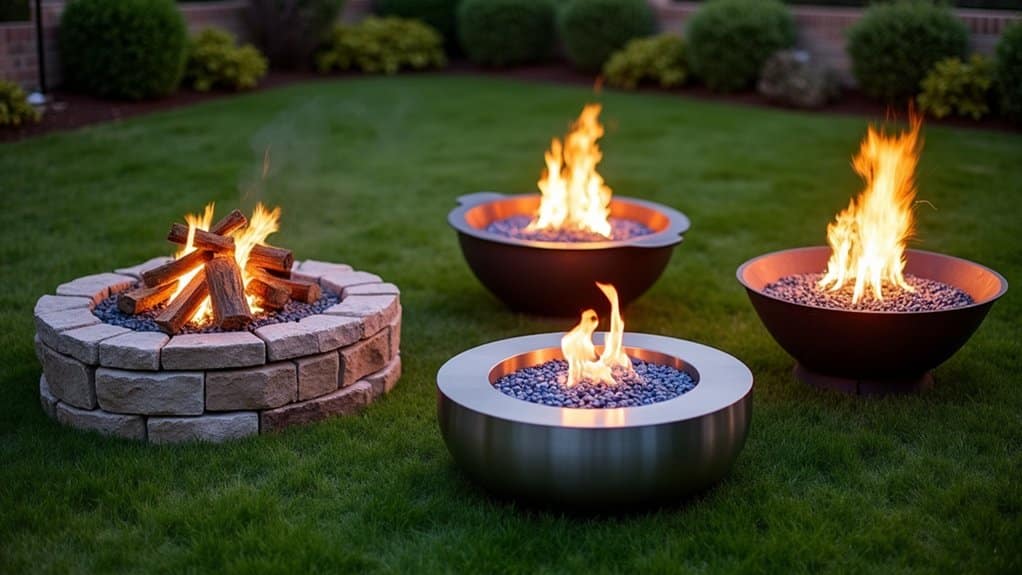
Your fire pit’s fuel type directly impacts both upfront costs and long-term expenses, with wood-burning units starting as low as $300 while natural gas systems can reach $5,000 or more for premium installations. Gas line installation alone adds $400 to $3,000 to your project budget, often requiring a licensed plumber or electrician for safe connection to your home’s existing supply. Propane and electric options fall between these extremes, with propane kits averaging $400 to $1,700 and electric models ranging from $100 to $1,500 depending on features.
Fuel Type Price Ranges
The fuel type you choose directly shapes both your upfront investment and long-term operating costs. Electric units run cheapest at $0.39 per hour ($580 seasonally), while wood follows at $0.60 per hour ($900 seasonally). Natural gas costs $1.06 per hour ($930 seasonally), and propane tops combustion fuels at $1.32 per hour ($1,200 seasonally).
Beyond mainstream options, wood pellets cost $0.34 per hour but demand 186 bags yearly at $8 each, totaling $1,488 seasonally. Ethanol fuel costs vary with frequent refills required, though you’ll get an eco-friendly burn. Gel fuel affordability stays moderate with no smoke and 2, 6 hours of burn time per use. Firelogs offer 3, 4 hour burns at lower costs than cordwood with medium smoke output.
Gas Line Installation Costs
If you’re installing a natural gas fire pit, running a dedicated gas line typically costs $15 to $25 per linear foot, with outdoor fire pit connections landing at the higher end, $20 to $25 per linear foot. Most outdoor runs average $833 to $1,020 per piping run, and labor alone accounts for roughly 50% of your total project cost.
Distance from your main gas connection, material choice, and trenching requirements ($5 to $12 per linear foot) all drive your final price. Licensed plumbers charge $45 to $150 per hour, with complex terrain increasing both time and expense. You’ll also need permits to meet local code restrictions, a non-negotiable step that protects both safety and property value impacts. Budget $500 to $2,000 for the complete gas line installation.
DIY vs. Professional Fire Pit Costs: The Real Difference
While a DIY fire pit kit runs $100 to $500 for basic models, and $500 to $3,000 for pre-packed component sets, professionally installed wood-burning pits start at $2,000 to $3,500, with custom masonry or gas systems exceeding $8,000. That gap reflects labor, insurance, licensing, equipment, and overhead baked into contractor pricing.
Don’t overlook hidden DIY costs. Delivery fees, tool rentals, overbuying materials, and correcting mistakes add up fast. Your DIY project duration typically consumes an entire weekend or longer, especially factoring in material transport and site prep. Professional installation time frames run shorter since contractors work full-time rather than around your schedule. They also handle site assessment, excavation, base installation, and cleanup. You’re paying for speed, expertise, and accountability.
Fire Pit Labor and Installation Costs
Labor typically accounts for 30% to 50% of your total fire pit project cost, with installation fees ranging from $300 to $1,500 depending on complexity. Handypersons charge $50 to $125 per hour, while gas plumbers run $45 to $150 per hour if you’re adding a gas line.
Labor cost variations depend on several factors. In-ground units require excavation, custom stonework demands masonry expertise, and gas conversions need licensed plumber integration. These additions compound quickly. A basic block firepit carries a two-hour minimum charge, while complex in-ground builds can consume 50% of a $1,000 to $3,000 budget.
Don’t overlook fire pit accessory costs when budgeting, spark screens, covers, and grates add expenses beyond base installation that affect your final number.
Hidden Fire Pit Costs: Gas Lines, Permits, and Excavation
Beyond the fire pit itself, you’ll face additional expenses that can drastically impact your total budget, gas line installation alone averages $500 to $2,000, with per-foot costs of $15 to $25 for outdoor runs plus $5 to $12 per linear foot for trenching. Permit and inspection fees, required by local codes for any new gas line, vary by location but are often folded into professional quotes, so confirm what’s included before you sign. Excavation costs escalate quickly based on distance from your main gas connection, site terrain, and pipe type, with CSST running $2 to $4 per foot and HDPE at $1 to $2 per foot.
Gas Line Installation
If your fire pit design runs on natural gas, you’ll need a dedicated gas line, and that’s where costs can climb quickly. Standard installation runs $14, $25 per linear foot, with a 50-foot run from your meter adding $2,000, $3,000. Total gas line work typically adds $1,500, $3,000 to your fire pit project budget.
Licensed natural gas plumbers charge $45, $200 per hour depending on your region. Trenching, maneuvering existing utilities, and site accessibility all drive costs higher. Extensions to existing lines cost $120, $1,350, significantly less than new installations.
Every installation requires pressure testing, leak detection, and building inspections to meet local codes. Skipping professional installation isn’t an option; compliance protects both your safety and your investment. Budget for permits, as extensions and new setups often trigger additional permit requirements.
Permit Fee Surprises
Gas line installation isn’t the only line item that catches homeowners off guard, permit fees for fire pits vary wildly by jurisdiction and can add hundreds of dollars you didn’t plan for. Regional fee variations are significant: Portland, TN charges 1% of project cost plus a $50 minimum, while Prince George’s County, MD totals $110 plus administrative and 10% technology surcharges. Berkeley, CA sets a $500 minimum for construction fire permits.
Watch for hidden permit add ons that inflate your budget. Portland doubles your permit fee if you start work before issuance. Prince George’s County tacks on a 10% technology fee across all fire-related permits. Plan review fees can equal 50% of your permit cost. Some jurisdictions, like Delaware, exempt recreational fire pits entirely, always verify local requirements first.
Excavation Cost Breakdown
Although above-ground fire pits sit directly on existing surfaces, in-ground installations demand excavation that can account for up to 50% of your total project labor cost. Standard backyard excavation runs $200 to $500, but rocky soil or uneven terrain pushes costs toward $1,000 when machinery and disposal fees apply. You’ll dig 12-24 inches deep to accommodate foundation, drainage, and structural components.
Backyard excavation challenges compound quickly. Hard-to-reach yards increase labor 20-50%, while gas line trenching adds $12-$25 per linear foot. Northeast homeowners face 20-30% higher labor rates regionally. Year round excavation concerns include proper drainage installation during digging to prevent water pooling that undermines your pit’s longevity. Site prep typically bundles excavation with gravel base ($100-$300) or concrete pad ($500-$2,000), so budget accordingly.
Annual Fire Pit Maintenance and Fuel Costs
How much should you budget each year to keep your fire pit running safely and efficiently? Gas fire pits typically require $150 to $400 annually for a maintenance package covering burner cleaning, ignition repair, and valve replacement. Wood-burning pits demand consistent ash removal, interior cleaning, and mortar touch-ups to guarantee long term durability. Seasonal maintenance, including corrosion treatment, protective coatings, and weatherproofing, prevents costly repairs down the line.
| Service | Gas Fire Pit Cost | Wood-Burning Cost |
|---|---|---|
| Annual Maintenance | $150, $400 | $80, $200 (sealing/repairs) |
| Fuel/Consumables | $100, $300+ (propane/gas) | Firewood varies by region |
| Corrosion Treatment | $70, $180 | $70, $180 |
You’ll also want to budget $50, $120 for cover replacements and $60, $150 for drainage inspections.
What You Can Build at Every Fire Pit Budget Level
Whether you’re working with a modest weekend budget or planning a full-scale outdoor renovation, your dollar amount dictates the materials, size, and complexity you can realistically achieve. Under $500, you’ll find portable units and simple metal ring pits over gravel. Between $500, $1,500, expect 36, 44 inch stainless steel or concrete installations with flexible placement. Budgets of $1,500, $3,000 grant custom masonry, 48, 60 inch diameters, and stone patio integration. At $3,000, $5,000, professional gas line work, in-ground construction, and 72-inch builds become feasible. Above $5,000, you’re investing in luxury outdoor amenities, premium natural stone, extensive landscaping, backyard lighting integration, and multi-feature entertaining areas with professional consultation throughout the build process.
Frequently Asked Questions
Does Adding a Fire Pit Increase Your Home’s Resale Value?
Yes, adding a fire pit increases your home’s resale value. According to NAR’s 2018 Remodeling Impact Report, you’ll see approximately a 67% ROI, meaning a $6,000 installation typically adds $4,000 in value. Your fire pit resale value also benefits from faster sales, with listings closing 2.8 days sooner on average. You’re fundamentally creating an improved outdoor living space that 89% of buyers consider essential, not optional.
How Far Should a Fire Pit Be From Your House?
You should place your fire pit at least 10 feet from your house, though appropriate fire pit placement typically means 15, 25 feet for wood-burning models that throw sparks. Gas fire pits can sit closer at 10 feet. Fire pit clearance requirements also apply to trees, fences, and sheds, maintain 10 feet horizontally and 21 feet vertically from overhanging branches. Always check local codes, since non-compliant placement can trigger fines or increase project costs.
Do You Need a Permit to Build a Backyard Fire Pit?
In most Wisconsin locations, you don’t need a permit for a small recreational fire pit, but you must still follow local fire pit regulations and local fire codes. Cities like Madison and Watertown allow backyard fire pits without permits if you meet setback and surface requirements. However, if you’re burning debris in DNR protection areas, you’ll need a free permit. Always check with your municipality first to avoid costly citations.
How Long Does a Typical Backyard Fire Pit Installation Take?
You’ll typically complete a backyard fire pit installation within two days. On Day 1, crews excavate, tamp, level, and lay the stone base, allowing it to set overnight. Day 2’s assembly, including gas line connections, wraps up in about four hours. Your total installation time from assessment to completion spans 1, 2 weeks. Key professional installation considerations include frozen ground extending timelines and scheduling assessments within seven days of initial contact.
What Fire Pit Shape Works Best for Small Backyard Spaces?
For small backyards, you’ll get the most from compact fire pit styles like square or rectangular models that tuck efficiently against walls or into corners. If you prefer a softer look, a circular fire pit design in the 24, 30 inch range creates a cozy gathering zone without dominating your space. Portable options like the Renegade offer flexible placement, and prefab kits keep installation costs manageable while maximizing every square foot.