

Fire pits, outdoor fireplaces, and your backyard’s layout intersect at three decision points: cost, heat performance, and functional fit. You’ll spend $500, $3,000 on a fire pit versus $5,000, $30,000+ on a fireplace. Fire pits radiate 360-degree warmth ideal for open yards, while fireplaces project directional heat that resists wind dispersal. Fire pits suit large gatherings; fireplaces anchor intimate, wind-shielded seating zones. Each difference below breaks down exactly which option matches your site conditions and budget.
Fire Pit vs Fireplace: Which One Wins and Why?
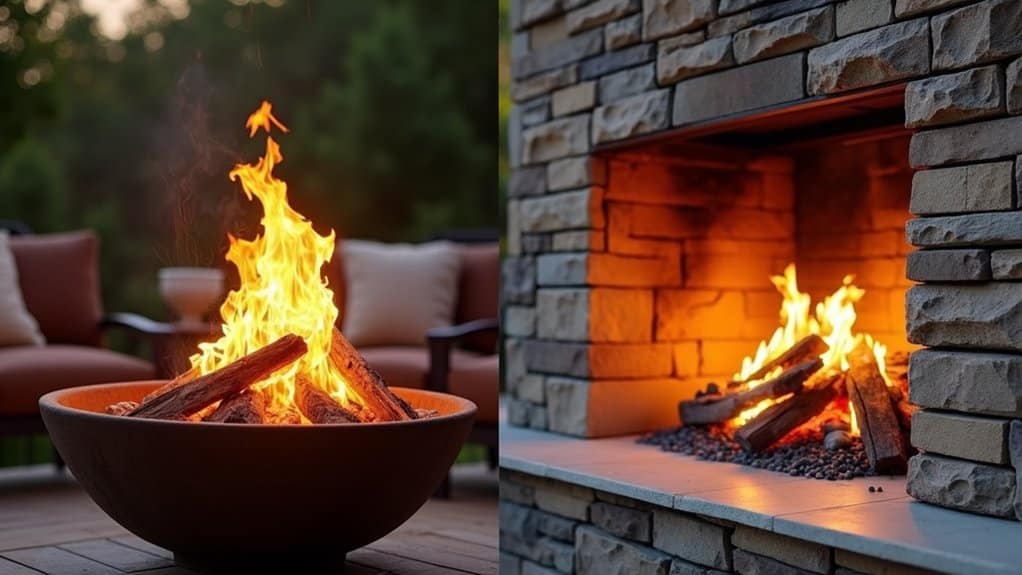
When you’re weighing a fire pit against an outdoor fireplace, the decision hinges on how you use your backyard, not just what looks best. Fire pits radiate 360-degree heat, making them ideal for larger gatherings on open patios or lawns. Fireplaces project heat directionally, suiting intimate seating arrangements anchored to a wall or pavilion.
From an aesthetic appeal standpoint, fire pits deliver casual versatility across rustic and modern styles, while fireplaces create formal architectural focal points with mantels and built-in seating. For functional convenience, fire pits require less space and adapt to compact yards. Fireplaces demand more footprint but offer enclosed flames, chimney-directed smoke, and superior wind protection, critical factors for safety-conscious households with children or pets. Both options also increase curb appeal, making them a smart investment that adds measurable resale value to your property.
What Does a Fire Pit vs Fireplace Cost to Build?
You’ll spend between $500 and $3,000 for a fire pit, with prefabricated steel or concrete bowls starting at a few hundred dollars and custom stonework installations reaching $5,000, while outdoor fireplaces typically run $5,000 to $10,000 due to masonry, chimney construction, and permitting requirements. If you’re working within a tighter budget, fire pit kits and prefab units under $1,000 offer a DIY-friendly path that eliminates professional labor costs entirely. Gas line installation adds expense to either option, but factoring fuel type early in your design process helps you control both upfront build costs and long-term operational spending. High-end fireplaces using brick and stone materials can push total project costs from $15,000 to well over $30,000, making the price gap between the two features even more significant.
Fire Pit Expenses
Fire pit costs break down into distinct tiers based on construction method, fuel type, and site conditions. Basic prefabricated units start at a few hundred dollars, while standard built options average $2,000 to $2,500. Custom designs with stonework push costs to $5,000, $9,500.
Your fuel source considerations directly impact budget. Wood-burning pits run $1,500 to $2,000, requiring minimal infrastructure. Gas models reach $6,000 to $10,000 due to burner systems and licensed line installation.
For DIY installation guidance, factor in site prep ($500, $2,000), permits ($50, $500), and hourly labor rates: masons charge $70, $100, electricians $50, $130. You’ll keep expenses lowest with concrete or steel materials and prefab kits that don’t require gas infrastructure. Fire pits also enhance your property’s functional value. Installation timelines are also budget-friendly, since fire pit projects typically wrap up in a couple of hours to a day or two.
Fireplace Construction Costs
Outdoor fireplaces demand a fundamentally different budget framework than fire pits, with construction costs reflecting their structural complexity. You’ll typically spend $8,000 to $25,000 for custom builds, while prefab units range $3,000 to $8,000. Masonry fireplaces require a full concrete foundation design, pushing costs to $15,000, $25,000 before finishing materials.
Labor alone adds $3,000 to $15,000, with installation timelines spanning one to three weeks. You’ll also need to budget $900 to $1,800 for gas line work if you’re choosing gas-fueled options. Local permitting requirements and strict code compliance further increase expenses, as fireplaces demand professional contractor oversight throughout construction. High-end custom outdoor fireplaces can exceed $50,000, making them the most significant hardscape investment in your backyard design.
DIY Savings Options
Because fire pits accommodate straightforward DIY assembly, they deliver the most dramatic cost savings between these two features. You’ll find pre built fire pits, including steel bowls, concrete rings, and prefabricated gas tables, available under $1,000, eliminating professional labor entirely. Heat-resistant pavers or stacked stone let you construct a functional unit with basic masonry skills and standard tools.
Outdoor fireplaces, by contrast, require licensed contractors, structural permits, and specialized brick or stone installation starting at $5,500 minimum. You can’t safely bypass professional involvement given the chimney engineering and combustion chamber requirements.
Fire pits also offer fuel type flexibility that compounds savings. You’ll select wood-burning, propane, natural gas, or gel fuel configurations based on your site conditions, operating budget, and local code requirements, each affecting long-term cost trajectories differently.
Which One Heats Your Backyard Better?
A fire pit radiates heat in a full 360° pattern, warming everyone around it evenly, while an outdoor fireplace projects intense, directional heat forward into a defined seating zone. Wind exposure considerably reduces a fire pit’s effectiveness since its open design lets gusts scatter warmth, whereas a fireplace’s enclosed structure shields the flame and maintains consistent output. If your backyard is sheltered and you’re hosting large gatherings, a fire pit delivers broad coverage, but for exposed sites or intimate spaces, a fireplace retains and directs heat far more dependably.
Heat Direction and Spread
Consider these thermal dynamics when planning your layout:
- Fire pits generate 30,000, 150,000 BTUs across a wide radiant field, ideal for open-plan gathering spaces.
- Fireplaces retain heat longer as masonry absorbs and re-radiates energy back toward you.
- Wind-blocked firebox designs deliver consistent warmth without dispersal loss.
- Larger backyards benefit from 360-degree spread; compact patios gain more from directional output.
Wind Impact on Warmth
Even when a fire pit delivers impressive BTU output, wind exposure can strip that warmth away before it reaches your seating area. Fire pit heat radiates in all directions, and even a slight breeze pushes warmth out of your gathering zone rather than retaining it. Fireplaces contain flames within a structure, allowing brick interiors and logs to radiate heat toward a defined seating area with effective flame stability.
Your wind protection mechanisms matter here. Fireplaces feature integrated back walls that block prevailing winds and reduce heat loss during use. Fire pits require supplemental solutions, stone walls measuring 24 to 36 inches provide breathable wind protection, while partial-height screens of 42 to 54 inches on the upwind side shield flames without sacrificing sightlines. Each approach demands site-specific wind analysis.
Consistent Heat Retention
When you’re weighing fire pits against outdoor fireplaces for consistent heat retention, the difference comes down to thermal mass versus radiant spread. Masonry fireplaces absorb combustion energy and re-radiate it steadily, delivering an extended heat span near the firebox. Fire pits, generating up to 150,000 BTUs, push radiant warmth consistency across broader zones omnidirectionally.
Your site layout determines which performs better:
- Wood-burning fire pits sustain stronger heat retention across open yards than gas alternatives.
- Cast iron or steel fire pits hold residual warmth longer with proper material selection.
- Enclosed masonry fireplaces prevent heat dissipation, concentrating output for intimate seating arrangements.
- Hardwood fuel outperforms propane in prolonged radiant delivery for either configuration.
Choose based on coverage needs, not just flame appeal.
Fire Pit or Fireplace for Entertaining Groups?
Gathering around an open flame shapes how your guests interact, and the choice between a fire pit and an outdoor fireplace fundamentally alters your entertaining layout. Fire pits support 360-degree seating flexibility, accommodating circular configurations where everyone faces the flame and each other. Their low profiles won’t block sight lines across your property, and they’ll warm guests within a 6-8 foot radius.
Outdoor fireplaces function as focal point design elements, directing heat forward into a defined seating zone. This single-sided orientation suits larger gatherings where you’re warming a specific area rather than encircling the flame. Fire pits average $500, $3,000 with DIY-friendly installation, while fireplaces range from $2,000, $10,000+, requiring professional construction for their architectural presence.
Choose a Fireplace for Privacy and Wind Cover
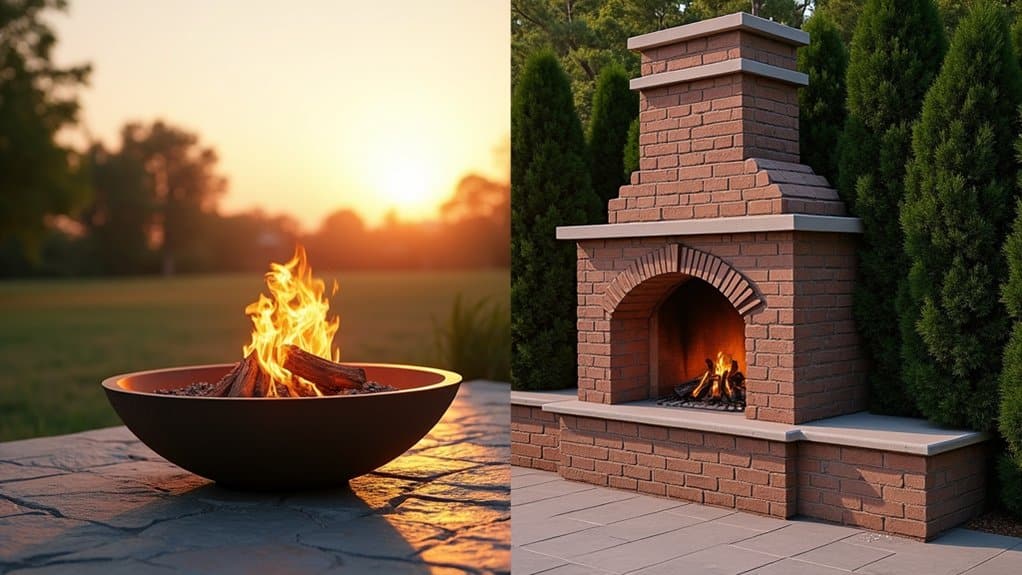
Because outdoor fireplaces incorporate full-height masonry walls into their structure, they’ll double as privacy barriers and wind blocks that standalone fire pits can’t replicate without added hardscape.
Outdoor fireplaces pull double duty, delivering built-in privacy walls and wind protection that standalone fire pits simply can’t match.
Consider these hardscape solutions when evaluating your site conditions:
- Full-height walls block wind gusts while creating visual separation between your gathering space and neighboring sightlines.
- Retaining walls carved into nooks position your fire feature within protected landscape zones for maximum wind coverage.
- Brussels Dimensional Stone delivers traditional aesthetics, while Lineo Dimensional Stone suits contemporary design languages.
- Professional installation guarantees structural integrity, especially where higher screens face greater wind force requiring concrete footings.
You’ll gain integrated privacy barriers without retrofitting glass guards or supplemental screens onto an exposed fire pit.
Fire Pit or Fireplace: How to Make the Final Call
Although both features deliver ambiance and warmth, your final decision hinges on five site-specific variables: available square footage, heat distribution needs, design language, budget range, and long-term maintenance commitment. Evaluate each factor against your property’s constraints before committing.
| Factor | Fire Pit | Outdoor Fireplace |
|---|---|---|
| Best For | Small yards, 360° heat, material flexibility | Large patios, directional warmth, architectural anchoring |
| Budget | $500, $3,000 (DIY-friendly) | $2,000, $10,000+ (pro install) |
| Maintenance | Ash removal, weather covers, surface touch-ups | Chimney inspections, masonry sealing |
Your space’s aesthetics evolution matters equally. If you’re prioritizing versatile gatherings and cost efficiency, choose a fire pit. If you want a permanent focal point that boosts property value, invest in a fireplace.
Frequently Asked Questions
Do Fire Pits or Outdoor Fireplaces Require More Building Permits to Install?
Outdoor fireplaces require substantially more building permits than fire pits. You’ll need separate permits for chimney construction, gas line connections, and masonry work, all governed by building code regulations that classify fireplaces as permanent structures. Fire pits, especially portable or low-profile models, typically bypass structural permits entirely. However, you should still verify local zoning requirements, as both features must comply with setback distances, open flame restrictions, and regional fire codes specific to your site.
Can You Move an Outdoor Fireplace to a Different Yard Location?
You can move an outdoor fireplace, but relocation feasibility depends heavily on its construction type. If you’ve built a custom masonry unit, you’ll need professional disassembly, structural reassessment, and permit re-compliance, often exceeding 50% of your original build cost. Portability considerations include re-verifying 10-foot clearances, evaluating prevailing wind patterns at the new position, and confirming utility reconnections for gas models. Free-standing units offer vastly easier repositioning than wall-attached designs.
How Long Does Fire Pit Installation Take Compared to a Fireplace?
You’ll find the estimated installation time for a propane fire pit ranges from just 1, 2 hours, while natural gas models require 1, 3 days due to licensed gas line work and permits. Fireplaces demand weeks of masonry, chimney construction, and foundation engineering. Factors affecting installation duration include fuel type, custom versus pre-made design complexity, material cure times, like 28 days for cement-set stone assemblies, and local permit scheduling, all shaping your project’s site-specific timeline.
Are Wood-Burning or Gas Fire Pits Cheaper to Set up Initially?
Wood-burning fire pits are cheaper to set up initially, averaging $650 compared to $1,700 for natural gas units. You’ll avoid gas line installation costs of $500 to $1,500, keeping your fuel costs lower from day one. Propane options narrow the gap at $300 to $950, but wood-burning DIY builds start as low as $50. You’ll also find that maintenance requirements stay simpler with wood-burning designs, reducing your overall upfront investment.
What Chimney Height Regulations Apply to Outdoor Wood-Burning Fireplaces?
You’ll need to follow the 3-2-10 rule: your chimney must extend at least 3 feet above the roof penetration point and rise 2 feet higher than any structure within 10 feet. Chimney height restrictions also require your stack to stand 2 feet taller than adjacent patio covers or your home’s roofline. Always verify your local fire codes, since some states mandate minimum heights of 18 feet above ground for outdoor wood-burning units.