Building a full swimming pool in Florida costs you between $35,000 and $120,000, with high-end custom builds pushing past $200,000. Your total depends on material, size, and region. Gunite averages $72,000, fiberglass hits $55,000, and vinyl lands near $44,000. A 14×28-foot baseline runs $42,000 to $95,000. Regional square-foot pricing ranges $95 to $250. Add-ons like cages, pavers, and spas stack fast. Budget 10% to 15% contingency. Let’s break down exactly where your dollars go.
Key Takeaways
- Most Florida pool builds cost between $35,000 and $120,000, with high-end custom projects exceeding $200,000.
- Pool size drives cost, ranging from $30,000 for a small 10×20 to $120,000 for a large 16×32.
- Material choice matters: gunite averages $72,000, fiberglass $55,000, and vinyl liner $44,000.
- Regional pricing varies widely, with Miami-Dade and Palm Beach hitting $165 to $250 per square foot.
- Add-ons like cages ($9,000, $22,000) and paver decking ($8,000, $18,000) increase costs, so budget 10 to 15% contingency.
The Cost to Build a Pool in Florida
The cost to build a pool in Florida depends on material, size, and site conditions. Most builds land between $35,000 and $120,000, though many standard installs push closer to $55,000 to $150,000+. A typical 14×28-foot baseline runs $42,000 to $95,000, while concrete/gunite builds often settle between $65,000 and $100,000. High-end custom projects can exceed $200,000. Understanding permits for Florida swimming pools is essential to ensure compliance with local regulations. Many homeowners may underestimate the paperwork involved and the time it takes to finalize approvals.
Florida pool cost also varies by region, with square-foot pricing near $95 to $150 in Central Florida and $165 to $250 in Palm Beach and Miami-Dade. Your swimming pool cost Florida estimate should factor excavation, permitted construction, finishes, and labor. Realistically, plan for $60,000 to $100,000 as your average build target.
What is the average cost to build a pool in Florida
The average cost to build a pool in Florida scales with size. A 14×28-foot medium pool runs $45,000 to $75,000, while a 16×32-foot large pool climbs to $65,000 to $120,000.
Factor in regional square-foot pricing: $95, $150 in Central Florida, up to $165, $250 in Palm Beach and Miami-Dade.
Don’t omit required add-ons. Budget $9,000, $22,000 for cages and $8,000, $18,000 for paver decking. Sum excavation, labor, finishes, decking, and features to calculate your true contract total.
What factors affect pool building costs in Florida
Material choice, size, region, and add-ons affect pool building costs in Florida. Gunite/concrete runs about $72,000, fiberglass around $55,000, and vinyl liner near $44,000. Size scales your total directly: a 10×20 lands at $30,000-$45,000, a 14×28 at $45,000-$75,000, and a 16×32 at $65,000-$120,000. Region matters too. Square-foot pricing spans $95-$150 in Central Florida, $135-$200 in Southeast Florida, and $165-$250 in Palm Beach and Miami-Dade. Add-ons stack quickly: pool cages cost $9,000-$22,000, paver decking $8,000-$18,000, and features like waterfalls, spas, and premium tile push you higher. Site conditions, excavation requirements, permitting, and regional labor rates further adjust your contract. Factor each line item individually, since finishes and feature upgrades ultimately determine where your project settles.
How do costs vary by pool type and size
Costs vary by pool type and size because both operate as independent cost multipliers that you price separately before combining. Material sets your baseline average.
| Pool Material | Florida Average |
|---|---|
| Gunite/Concrete | $72,000 |
| Fiberglass | $55,000 |
| Vinyl Liner | $44,000 |
Size layers onto that baseline. A small 10×20 pool runs $30,000 to $45,000, a medium 14×28 lands at $45,000 to $75,000, and a large 16×32 climbs to $65,000 to $120,000. Concrete costs more than fiberglass because it grants design flexibility, custom finishes, and higher construction intensity.
To estimate, multiply your material baseline by your size bracket’s upper range. A concrete 16×32 build, for example, pushes toward the high end, while a small fiberglass pool stays lean and predictable.
What extra features add to the total cost
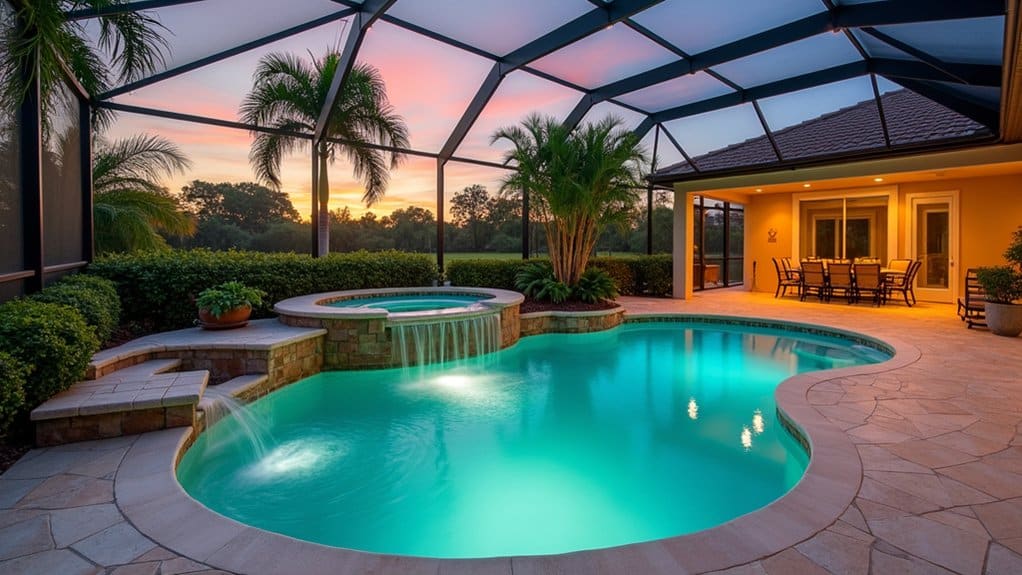
Extra features add to the total cost as separate line items stacked on top of your material and size baseline. Budget a pool cage at $9,000 to $22,000, since Florida code and screen enclosures scale with perimeter and mesh spec. Paver decking runs $8,000 to $18,000, driven by square footage, base prep, and joint sand. Waterfalls, spas, premium tile, and upgraded interior finishes push you toward the high-end band. Full luxury resort-style configurations can hit $140,000 to $250,000-plus once you layer multiple features. Don’t overlook site conditions, excavation depth, soil, and setback constraints materially raise your contract price. Each upgrade is priced independently, so you should itemize every component: excavation, labor, finish, decking, cage, and feature packages. That’s how you’ll model your true total accurately.
How can you save money building a pool in Florida
Save money building a pool in Florida by choosing a smaller footprint and a material that fits Florida’s climate. A 10×20 pool runs $30,000 to $45,000, well below a 16×32 at $65,000 to $120,000. Fiberglass averages $55,000 versus gunite’s $72,000, so it’ll trim your base cost while resisting humidity and algae. Skip premium tile, waterfalls, and spas that push projects into the $120,000-plus range. Phase your add-ons: defer paver decking ($8,000 to $18,000) or the cage ($9,000 to $22,000) until later. Build in a lower-cost region. Central Florida runs $95 to $150 per square foot versus Palm Beach’s $165 to $250. Finally, get multiple permitted quotes and confirm your site conditions won’t trigger expensive excavation surprises.
How do you budget and finance your Florida pool
Budget a Florida pool by starting with a realistic anchor: $60,000 to $100,000 for a full inground build, not the entry-level quotes. Break your budget into line items: excavation, shell material, finish, decking, cage, and feature upgrades. Concrete/gunite averages $72,000, fiberglass $55,000, and vinyl $44,000, so lock your material first. Add $9,000 to $22,000 for a cage and $8,000 to $18,000 for paver decking. Reserve 10 to 15 percent contingency for site conditions and permitting.
For financing, you’ve got options: home equity loans, HELOCs, cash-out refinancing, and pool-specific installment loans. Compare APR, term length, and total interest, not just monthly payments. Get itemized contractor quotes so your loan matches actual scope. Confirm permit costs upfront, since they’re mandatory and factor into your total.
Conclusion
The real cost of a Florida pool is more than the shell; it stacks up across excavation, permitting, finishes, decking, a screen cage, and equipment, and shifts with size, site, and features. Seeing the full picture up front lets a homeowner budget honestly and avoid mid-build surprises. Innovative Outdoor Living prices Florida pools transparently, line by line, and builds them to code, so the number in the contract is the number that makes sense from start to finish.
Build the Custom Pool of Your Dreams
From permits and design to construction and completion, every custom pool deserves expert planning and execution. At Innovative Outdoor Living in Jupiter, FL, our experienced team provides trusted Pool Construction with expert craftsmanship and premium materials. Call +1 (561) 594-1495 today and start planning your dream pool.
Frequently Asked Questions
How Long Does It Take to Build a Pool in Florida?
Most Florida pools take about two to four months from contract to first swim. The same variables that drive cost, excavation, permitting, finishes, decking, and a screen cage, also shape the timeline, with permitting and site conditions usually the biggest bottlenecks. Weather and inspection scheduling can add time too. A contractor can provide a firm project schedule once the design and permits are in place.
Do I Need a Permit to Build a Pool in Florida?
Yes. Florida requires a building permit for every inground pool, enforced under the Florida Building Code and local jurisdiction rules. The submission includes site plans, structural specs, and barrier or safety-compliance documents meeting the Residential Swimming Pool Safety Act, usually with electrical and plumbing sub-permits as well. The contractor typically pulls these, but the homeowner remains responsible for making sure the work is properly permitted.
Does Adding a Pool Increase My Florida Home’s Value?
Usually, yes, since the climate makes a pool a high-demand feature in Florida. It typically recovers a portion, not all, of the build cost, so a full return on a $70,000 to $120,000 investment is unlikely. The gain depends on neighbourhood comps, the pool’s condition, and buyer demand. A well-maintained, permitted pool with quality decking and a screen cage delivers the strongest resale impact.
What Are the Ongoing Maintenance Costs for a Florida Pool?
Ongoing costs generally run a few hundred dollars a month once everything is added up. Chemicals, electricity for the pump and any heater, water top-offs, and periodic cleaning are the recurring items, with occasional equipment servicing or a resurface further out. A saltwater system trims chemical costs but adds an eventual salt-cell replacement, while a variable-speed pump lowers the energy bill. Doing the upkeep yourself keeps it lower; a monthly service adds to it.
What Is the Best Time of Year to Build a Pool in Florida?
Fall and winter, roughly October through February, tend to be the best window. Those months bring lower demand, faster permitting, and less rain to stall excavation, along with better contractor availability and pricing before the spring rush. Building in summer often means storm delays, saturated soil, and booked crews. Booking early lines the pool up to be ready by peak season without the seasonal markup.